
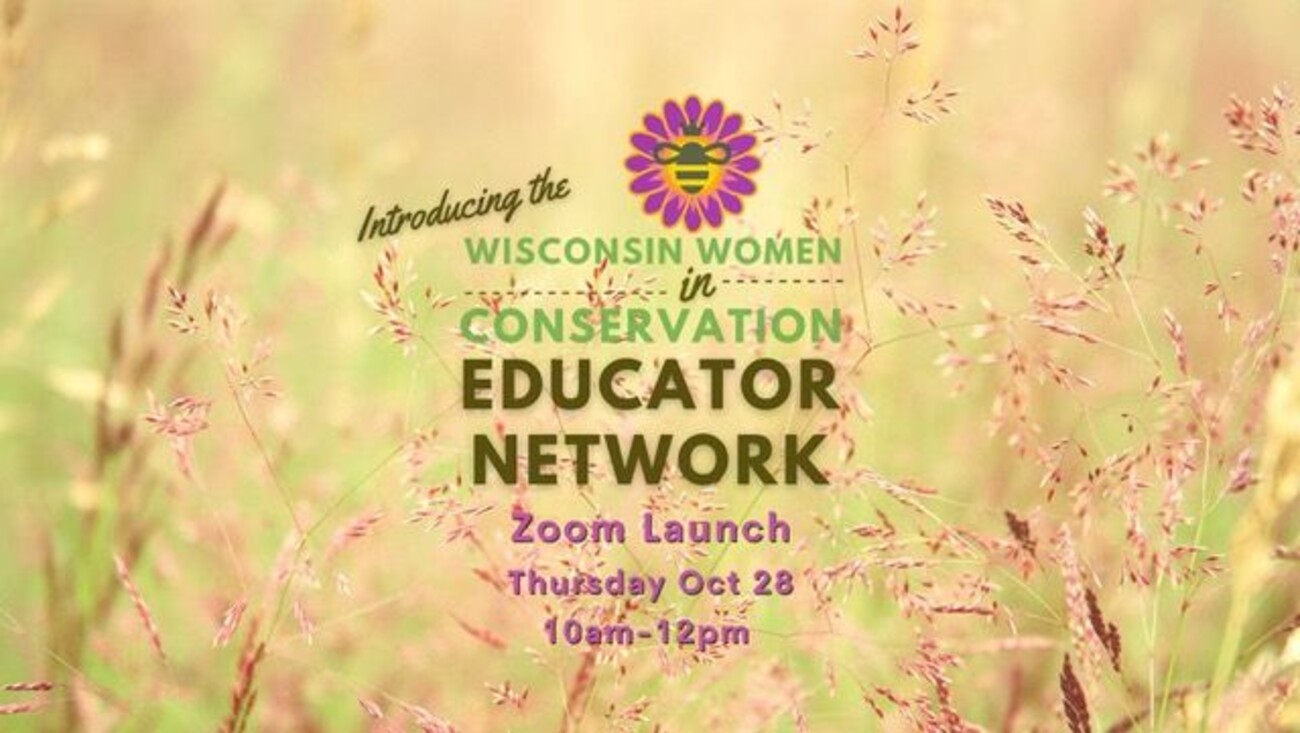
Chippewa Falls, WI - Citing the growing influence of women owning and managing land in Wisconsin, a coalition of agriculture and conservation organizations has announced the launch of a Wisconsin Women in Conservation Educator Network to convene, equip, and support conservation educators, professionals and volunteers who work with women landowners and farmers across the state. The virtual Kick Off of the network is October 28, from 10am til noon on Zoom, and will include both a statewide convening and breakouts in regional groups. All conservation educators are invited to participate, both men and women, from agency staff to non-profit volunteers. Pre-registration is required, but free, at WiWiC.org.
The network is being facilitated by the Wisconsin Women in Conservation project (WiWiC), a state-wide collaborative effort led by the Michael Fields Agricultural Institute in partnership with Wisconsin Farmers Union, Renewing the Countryside, E Resources Group and the Midwest Organic and Sustainable Education Service (MOSES) with support from the Natural Resources Conservation Service (NRCS).
“The goal of this inclusive new network is to for the first time connect these educators on a regular basis to collaboratively share challenges and best practices when it comes to reaching women landowners,” said Dr. Esther Shekinah, WiWiC Project Lead, and a Research Agronomist with the Michael Fields Agricultural Institute. “This launch is just the start. WiWiC will facilitate bi-annual meet-ups like this, as well as regional annual summits. We hope the result will be the development of cooperative strategies for working together and provide women farmers and landowners the tools they want and need to get conservation practices implemented on their land.”
Women landowners are a growing demographic. The 2017 Census recorded 38,509 female producers in Wisconsin, showing that women make up 35 percent of all producers in the state, which is slightly higher than the national average of 30 percent. But women are a group that has been traditionally underserved by federal and state conservation agencies.
“Women have more influence than ever over the future of land and water in Wisconsin, and we need to be intentional about serving them with conservation education and incentive programs,” said Shekinah. “Over the course of three years, the WiWiC team is testing a variety of methods and tools, and using survey instruments to determine what works best. Through the WiWiC Educator Network, we hope to share our research with the conservation community working with women, and collaboratively develop best practices for outreach and resource delivery.”
This unique three-year WiWiC initiative is collaboratively engaging women landowners across the state through workshops, field days, farm tours, mentorships, media content, email resource communications and other learning opportunities. The project began with virtual workshops in March of 2021, and has so far hosted five on-farm field days and 15 virtual events, reaching a total of 1200 women. A team of Regional Coordinators leads cohorts of women landowners in six different regions to network and share resources, as well as connecting them to regional NRCS agency staff and programs. Women also have the opportunity to work with WiWiC Conservation Coaches, fifteen experienced women landowners with particular expertise in different aspects of conservation across the state. Each Conservation Coach will lead a Field Day on their property over the course of the project.
A signature feature of the project, in both virtual and in-person events, is connecting women with each other in Learning Circles. In the Learning Circle model, professionals and attendees alike are given time and space to share information, needs, and resources with each other, rather than just receive content from experts. Regional events facilitate resource sharing, mentorship and support among neighboring women landowners.
“Women landowners and farmers are an increasingly significant demographic to reach with land conservation education and resources. Through the Wisconsin Women in Conservation Educator Network, we hope to provide educators and conservation professionals with the tools, data, research and support to best assist women in achieving their unique conservation goals," said Angela Biggs, NRCS Wisconsin State Conservationist. "I’m excited to be a part of this Network, and excited to see what we can do to impact the landscape in Wisconsin and beyond. As a woman conservationist for the USDA’s Natural Resources Conservation Service, it is my goal to continue to partner with all farmers and landowners, especially women, to implement conservation that will keep our lands productive and profitable for generations to come.”
Interested individuals who cannot attend this launch event on the 28th but would like to be involved with the Educator Network should contact [email protected]. Wisconsin Women in Conservation is planning a state-wide Conservation Plan Webinar this winter, as well as six regional on-farm field days and 12 Learning Circle events across the state in 2022, in addition to virtual events. WiWiC publishes a monthly e-newsletter, a Blog and Facebook, Pinterest and Instagram content. The group will launch a Listserv this fall. To stay informed of upcoming events, sign up for the e-newsletter at WiWiC.org.###
Memberships
Eau Claire Parent, Rich Spindler, Announces School Board Candidacy
Today Rich Spindler, an Eau Claire resident and parent announced that he will begin circulating his nomination papers for the Eau Claire School District School Board. Rarely do school districts get enough people to run for school board positions. The Eau Claire District is privileged to have a new candidate with Rich's credentials and skills.
Late last summer I had the privilege of meeting Rich Spindler for coffee. Rich was just starting to tell others about his intended candidacy and I felt privileged to sit with him to understand why he wanted this position. That Friday morning when he came into the coffee shop with his bicycle helmet tucked under his arm, I caught my first glimpse of a man that not only talks the talk but walks the walk. Or is it rides the trail.
When people talk about local control there are very few places in local control where individuals can make a real difference. Certainly city councils, county and town boards and their appointed committees are all places of influence. But the influence of how our education monies and education strategies are both created and expended can have generational impact on our community. Rich Spindler believes that with his commitment as a parent, educator and community volunteer, he can bring generational improvements to our school district and community.
But Rich is also a realist. In both his public and private business experience he has learned that bureaucratic change must be done thoughtfully as well as decisively. Rich has worked not only as an educator but also as an electrical engineer for Bell Labs. Later in his career, Spindler worked as a software programmer both in the private and public sectors.
With his masters in both engineering and mathematics as well as his PH.D. in mathematics, Rich has truly had an expanding career. All this while he has also been active in his community's public education. While he currently is serving on the Parent Advisory Council in Eau Claire, he also served on an equivalent body when his family lived in Bemidji where Rich served as a Bemidji State University faculty member. For nearly eight years Rich has been volunteering in our public school classrooms.
It wasn't until our Friday morning coffee that I truly began to understand the scope of Rich's contributions to our community and environment. Currently serving on the Board of Wisconsin Conservation Voters and past officer of the statewide John Muir Chapter or the Sierra club are strong indications of Rich's dedication and how others recognize the depth he brings to their organizations as a leader.
As Rich started off to work (Rich currently is a UWEC mathematics instuctor) donning his bicycle helmet I asked if he rides his bike often. He replied, "I have to, I told my daughter it was the best way to get around town and I best show her how it's done." As he rode down the Chippewa River bike trail that runs behind the coffee shop I decided that there was a guy I'd partner with on a tandem bike ride. Not only would he take care of his part, he'd be encouraging me to do my part too. -saw-

Press releases and other content not written by a specific Eye On Dunn County author are listed as Eye On Dunn County Staff.


Add new comment