
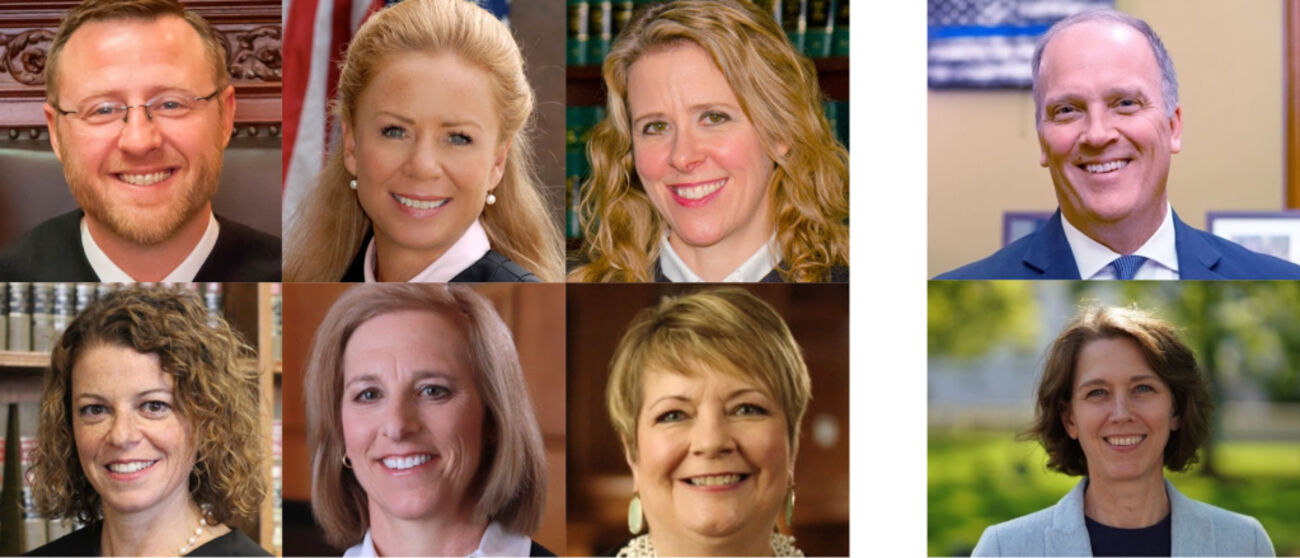
The justices of the Wisconsin Supreme Court, clockwise from top left: Brian Hagedorn, Annette Ziegler, Rebecca Bradley, Waukesha County Circuit Court Judge Brad Schimel, Dane County Circuit Court Judge Susan Crawford, Janet Protasiewicz, Jill Karofsky, and Rebecca Dallet. Schimel and Crawford are running for the open seat on the court.
Wisconsin still has highest percentage of female state Supeme Court justices in U.S.
The state is experiencing another record-breaking race in terms of political spending. Some research suggests gender is one cause.
By Peter Cameron, THE BADGER PROJECT
The highly politicized race for the Wisconsin Supreme Court has garnered national attention and is once again on track to top spending records. The election could also affect the court’s notable gender makeup.
With six of seven female justices, the Wisconsin Supreme Court has the highest proportion of women — 86 percent — of all the state Supreme Courts in the country, an analysis by The Badger Project found.
Brad Schimel, the right-leaning candidate and current Waukesha County Circuit judge, is running against left-leaning candidate and Dane County Circuit Judge Susan Crawford to replace the retiring, left-leaning Justice Ann Walsh Bradley.
If Schimel wins, the court will consist of five women and two men, changing the gender composition to 71% female.
Across the country, 147 of the approximate 327 sitting justices – about 45% – on the highest courts in each state are women, according to The Badger Project analysis.
That number has slowly increased. In 2023, the last time The Badger Project ran these numbers, 41% of all justices on top state courts were female. In 2020, 38% were female.
Wisconsin Supreme Court justices serve 10-year terms and earn an annual salary of about $196,000.
The next two state courts with the highest proportion of female to male justices are the benches in Washington and Illinois.
Six of Washington’s nine high court justices, or about 71%, are women, and five of Illinois’ seven Supreme Court judges are women, also a proportion of 71%.
No state high court is composed of only men, though in 2023, South Carolina had five male justices and no female justices. In 2025, South Carolina remains at the bottom with four male justices and one female justice, a proportion of 11%. Mississippi sits right above at 14%.
The U.S. Supreme Court’s four women justices give it a female composition of about 44%.
Though the Wisconsin Supreme Court may be a ground-breaker in gender makeup, it is not racially diverse. All the justices are white. The last non-white judge to sit on the court was Justice Louis Butler, appointed to the state’s highest court by former Gov. Jim Doyle, a Democrat, in 2004.
Butler lost his reelection campaign in 2008 to Michael Gableman, a white man.
Ideological composition
The Wisconsin Supreme Court’s six female justices are generally seen as being divided 4-2 on the ideological spectrum. The seventh justice, Brian Hagedorn, is a somewhat independent-minded, right-leaning justice and the court’s lone male at the moment.
The election is simple in that a victory for the left-leaning candidate would maintain the 4-3 status quo, and a right-leaning victory would flip the ideological balance toward conservatives.
Many of the cases the court rules on do not divide the justices ideologically, according to a March 12 analysis from the University of Wisconsin Law School’s State Democracy Research Initiative.
In the 2023-2024 term, the Wisconsin Supreme Court decided 14 cases, and the bench split along partisan lines only four times.
However, issues likely to divide the court ideologically in the future include abortion, collective bargaining rights for public sector unions and voting rights, such as absentee voting and voter ID laws.
Effect of gender on judicial outcomes
A 2010 study on female federal appellate judges suggests that their presence rarely affects the outcomes of cases.
“Rarely, though,” the study reports, “is not never.”
The study, “Untangling the Causal Effects of Sex on Judging” by Christina Boyd and others, found an exception when courts rule on gender discrimination disputes.
The presence of female judges often caused male judges “to vote in a way they otherwise would not – in favor of plaintiffs,” the study reported.
Sally Kenney, a political science professor at Tulane University and an expert on women in the global judiciary, favors deemphasizing Boyd’s study and recognizing that Boyd’s research found no differences in every other area of law it examined.

Using gender to explain how judges decide cases is not “very helpful,” but gender can be relevant in evaluating how judges ascend to the bench, Kenney said.
State-level election campaigns for female judicial candidates often must spend more per vote than for men, Kenney said. Federally, female judges face double standards in the types of questions they’re asked during confirmation hearings and can be approved at lower rates, she added.
Ultimately, women are significantly represented in the legal profession yet continually underrepresented in the judiciary, Kenney said.
In her 2013 book, “Gender and Justice: Why Women in the Judiciary Really Matter” Kenney argued that one reason feminists may seek out evidence that a judge’s gender influences how he or she decides a case as a way to argue that more women should hold positions in the judiciary.
It’s less a matter of how women judges will decide cases and more that they are in a position to decide cases and work within a system that doesn’t unfairly exclude them, Kenney explained.
“It’s just a fundamental part of democracy that women participate,” she said.
Tone of campaign
It’s also common to paint female candidates in judicial elections as soft on crime, especially if they previously worked as a defense attorney.
That’s “page one of the playbook,” Kenney said.
Though both candidates in the race have worked as prosecutors, both sides have attacked the other repeatedly in TV advertisements for being "soft on crime."
This is an age-old tactic that generally hurts female candidates more than their male counterparts and acts to simplify what’s at stake in a judicial election, Kenney said.
The Wisconsin Supreme Court hears relatively few criminal cases.
Percentage of female justices on top courts in each state
| RANK | STATE | MEN | FEMALE | TOTAL | PERCENTAGE | NOTES |
| 1 | Wisconsin | 1 | 6 | 7 | 86% | |
| 2 | Illinois | 2 | 5 | 7 | 71% | |
| 2 | Washington | 3 | 6 | 9 | 71% | |
| 4 | New Mexico | 2 | 3 | 5 | 60% | |
| 4 | Rhode Island | 2 | 3 | 5 | 60% | |
| 4 | Tenessee | 2 | 3 | 5 | 60% | |
| 4 | Utah | 2 | 3 | 5 | 60% | |
| 4 | Wyoming | 2 | 3 | 5 | 60% | |
| 4 | Arkansas | 3 | 4 | 7 | 60% | |
| 4 | California | 3 | 4 | 7 | 60% | |
| 4 | Maryland | 4 | 3 | 7 | 60% | |
| 4 | Michigan | 2 | 5 | 7 | 60% | |
| 13 | Minnesota | 3 | 4 | 7 | 57% | |
| 13 | Nevada | 2 | 5 | 7 | 57% | |
| 13 | New Jersey | 4 | 3 | 7 | 57% | |
| 13 | Pennsylvania | 4 | 3 | 7 | 57% | |
| 13 | New York | 3 | 4 | 7 | 57% | |
| 13 | Colorado | 4 | 3 | 7 | 57% | |
| 19 | Kansas | 4 | 3 | 7 | 50% | |
| 20 | Kentucky | 3 | 4 | 7 | 44% | |
| 21 | Massachusetts | 3 | 4 | 7 | 43% | |
| 21 | Missouri | 3 | 4 | 7 | 43% | |
| 21 | Montana | 4 | 3 | 7 | 43% | |
| 21 | Ohio | 4 | 3 | 7 | 43% | |
| 21 | Oregon | 4 | 3 | 7 | 43% | |
| 21 | Alaska | 2 | 3 | 5 | 43% | |
| 21 | Delware | 3 | 2 | 5 | 43% | |
| 21 | Hawaii | 3 | 2 | 5 | 43% | |
| 21 | Idaho | 2 | 3 | 5 | 43% | |
| 21 | South Dakota | 3 | 2 | 5 | 43% | |
| 21 | Vermont | 3 | 2 | 5 | 43% | |
| 32 | West Virginia | 3 | 2 | 5 | 40% | |
| 32 | Georgia | 5 | 4 | 9 | 40% | |
| 32 | Oklahoma | 6 | 2 | 8 | 40% | one vacancy |
| 32 | Texas | 6 | 3 | 9 | 40% | |
| 32 | Arizona | 4 | 3 | 7 | 40% | |
| 32 | Connecticut | 4 | 2 | 6 | 40% | |
| 38 | Florida | 4 | 3 | 7 | 33% | |
| 38 | Iowa | 5 | 2 | 7 | 33% | |
| 38 | Nebraska | 5 | 2 | 7 | 33% | |
| 41 | North Carolina | 4 | 3 | 7 | 29% | |
| 41 | Virginia | 5 | 2 | 7 | 29% | |
| 41 | Alabama | 7 | 2 | 9 | 29% | |
| 44 | Maine | 4 | 2 | 6 | 25% | |
| 45 | Indiana | 4 | 1 | 5 | 22% | |
| 46 | New Hampshire | 3 | 2 | 5 | 20% | |
| 46 | North Dakota | 4 | 1 | 5 | 20% | |
| 46 | Louisiana | 6 | 1 | 7 | 20% | |
| 49 | Mississippi | 8 | 1 | 9 | 14% | |
| 50 | South Carolina | 4 | 1 | 5 | 11% | |
| TOTAL | 180 | 147 | 327 | 45% |
Sreejita Patra, junior investigator, contributed to this report.
The Badger Project is a nonpartisan, citizen-supported journalism nonprofit in Wisconsin.
This article first appeared on The Badger Project and is republished here under a Creative Commons license.
Memberships

The Badger Project is a nonpartisan, citizen-supported journalism nonprofit in Wisconsin that investigates government, politics and related matters.


Add new comment