
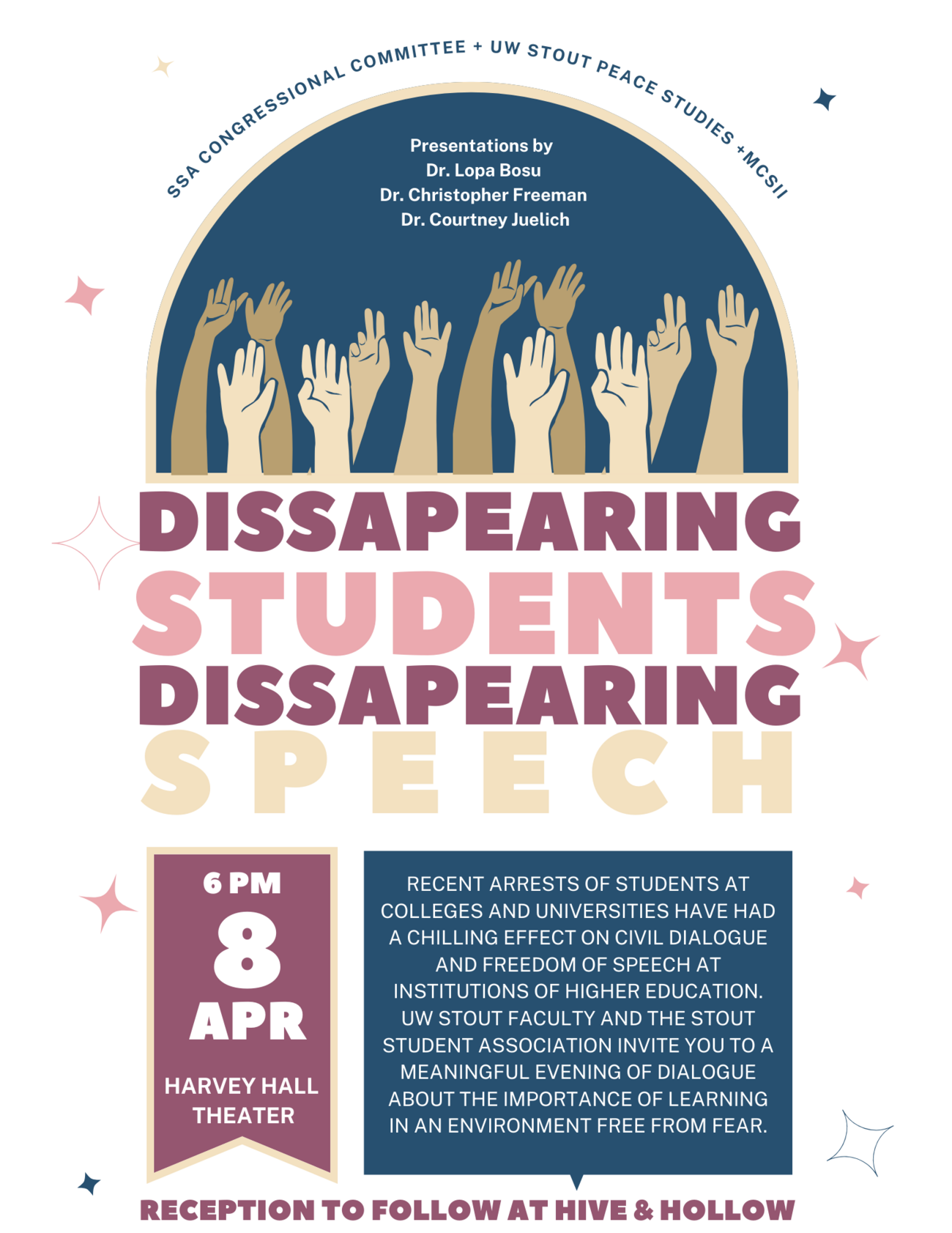
The Menard Center for the Study of Institutions and Innovation hosted a free speech event at UW-Stout on the evening of April 8, 2025. The Harvey Hall event was well-attended and included presentations by Stout professors Dr. Lopa Bosu, Dr. Christopher Freeman, Dr. Courtney Juelich, and two Stout Student Association members.
The discussion was thought-provoking and current, covering issues of free speech in a democracy and the history of free speech worldwide. The panel fielded questions from the audience, and there was a conversation around the issues of making students from Stout feel more welcomed and free to speak in the community at large. There was an emphasis on free speech in teaching and learning, and a lovely reception followed at Hive and Hollow with international food.
The following is a machine-generated transcript of the discussion. Note that it undoubtedly has errors.
Chris 00:07
Well, hello. Thank you so much for being here today.
Sophia 00:16
So wonderful to see really a lot of community members mixed with a lot of students. So that's really, really powerful and really awesome. My name is Sophia. I am taught by these amazing people up here. I'm a senior this year in the Applied Social Science major. I am the Director of Legislative Affairs for our student government. And I am joined by my best friend and roommate and partner in crime and everything, Chris. She can introduce herself partner in crime. Okay,
Chris 00:42
hi everyone. I'm Chris. I'm a vice president of SSA. I'm also taught by these amazing people up here. And yes, I wouldn't say partner in crime, but this is my best friend, Sophia, and we will be moderating for today, so I have some introductions before we get started.
Sophia 01:02
Lopa Basu is a professor of English and UW Stout. She teaches composition, post 911 American literature and graphic earrings. Hello. Oh, here we go. And then right next to we have the wonderful Courtney julick. She is an assistant professor of political science. She teaches me a lot of things, and her research mostly focuses on electoral laws and equity.
Chris 01:31
And then finally, but not least, Chris Freeman is a history teacher, passionate advocate of peace and non violence, and we'll read his script tonight so he doesn't get into any trouble. So one of you like to start, how do we want to do this down the line here? Um,
Chris Freeman 02:05
this is just so much fun. Can you even believe it? I mean, just think about the context for this for a second. Um, our liberal institutions of Republican values have completely failed us. Um, they failed our country and they failed our students, but ours hasn't they gave us this theater and they gave us the place. We could talk about what's happening. We can bear witness to the historical present, and we'll take a number of different ways in which we could think about how we can contextualize the place that we find ourselves in, in this historical present that is like, I like see a lot of opportunity here. I know that I see a lot of fear in my students faces, and I also see a lot of anger, and I see a lot of that on the post of a lot of my friends, and I just want to let you know that anger and fear are the conditions that produce tyranny. So if you're reproducing fear and you're reproducing anger, you're creating exactly the environment that you're trying to prevent. So please reconsider how we are in the public spheres, how we are when we perform our values. And so what I wanted to talk about tonight, of course, you know what? I love, the theater, and where are we right now? We're in a theater and thinking about the theatrical and the dramatic, and how that was the essential way in which the early Athenians who could teach us a lot about the nature of democracy and performing our values. It's a place in which the citizenry came together. There were 150 Deans throughout Attica, the place that the Athenians called home. And if each of those places didn't have a theater, they had access to a theater. And that's where they gathered. So they gathered with their neighbors. That's what they gathered with their citizens. That's where they gathered. Tell the stories. Of course, they saw dramas performed there, but that's where they came together. And I think this is important without fear and without anger. I mean, that's where they fought tyranny. 24/7, it was a full time job, because you live in a democracy, and I don't think we're prepared for that job. And I think that we could think about, you know, why the Athenians did it as they trained for it. I don't think we've been training, training ourselves in terms of how we fight tyranny. And the great training ground for the great school of Hellas, the School of the Greeks, was in the theater. So that's kind of what I want to talk about today. I wrote a three act play, and I know I'm supposed to stick to my script, so I'll get back to it pretty quickly. But I kind of screwed up because I was trying to write a three act play, but then I wrote a four act play, and I'm like, Oh my God, there's no four act Greek dramas. What the hell did I do? Nails? I changed the first act into a pro. Me, and it's really an establishing shot that I'm going to give to you. I had the great fortune with Dr you look, to bring 21 staff students to crawl around the ancient Greek monuments, to investigate what it was about the Greeks that made them so Greek. We cry. We climbed on the Acropolis, we we poked around in the panics, you know, with a where they gather to perform their democracy. We were in agora, peering into the, you know, the heart of what made this kind of to hell on a calm, this Greek thing pulse with life. But then the most important place we went is the place that I got lost from the students because I wasn't paying attention, and they went one way and one the other way. That's like, Where do my students go? I wonder where they are. Well, you know where they were, and they were at the theater of Genesis in the south side of the Acropolis. And we don't know how important that was to the Athenian democracy. 15,000 people could fit there. And that's where they came, under the clear light of day, under the God, God light. Lico was Genis light born Apollo so they could talk about true things. They could test their values and flex them. And the theater that really, you know, made them have to consider deeply about what it was about those values that could help them overcome conflict. You know what? They didn't use there. They didn't use any data. You know, they didn't they didn't use critical analysis. They didn't use critical theory. They didn't even use any facts, but they defended, they defended against tyranny like hell. And they learn about how you how you defend against tyranny, by thinking about how you perform your values, what you lean on and for the Greeks, they thought about what motivated them, it wasn't what was on the outside, it was what was on the inside, and that's what made them fight like hell to protect their freedoms in a way in which that I think maybe contemporary Americans could reflect on them, but not that we're doing it wrong. But there's other ways of doing things. So in my establishing shot, I tried to position the fact that we were climbing around these monuments to the values, the things that motivated, you know, Greeks and their democracy, especially the Athenians and healthy physicians themselves, in relationship to the fighting of tyranny and tyrannos. And I kept that thinking about the things I could describe to you guys to set the stage for, like, how and why this is such a powerful part of the democratic experience. And I think if I could take you guys anywhere right now, if I could go anywhere in Greece, I would take you guys to heraclium, and I take you we go out in front of the grave of Nico's cousin zakis. And this is what I want you to know, is the Greeks have been fighting tyranny like hell for 2500 years, from Pericles to cousin zakis. I would take you to his grave, and on that grave, the gravestone of gravestones is a testament to the Greek values. It helps you understand the connection between values and fighting tyranny. The gravestone says, Then Alpi zodipa, then folding my deep Bucha imma left the rose, I hope for nothing. I fear for nothing. I am free, and that's where I would go, because it gives us some of the motivating ideas that make people want to act, and that's what the drama is all about. It comes from the verb drayo, which means to act. It doesn't mean to post. It means to act. Oh, it's not fair the way we train our kids about democracy, we give them unrealistic expectations. You know that they can do it from the comfort of their own home in a safe space. The Safe Space is being in a space where you can operate without fear, without anger, we can explore. You know, you can stretch your values to really ask questions about yourself and who we are, where we're going, but most importantly, how we can defend against tyrannos. I'm telling it's a full time job. The Greeks did a really good job of it, the Athenians especially. Just think about it. We can't, we can't impeach people that have been impeached for committing crimes. We're totally incapable of acting to protect democracy and against the threat of tyrannos. Who they impeach? They impeach their heroes because they were a threat. Their power was the threat. They impeached Miltiades, Themistocles, Pericles, Alcibiades, we can't even impeach criminals when we get a very different understanding of what to act means and how we take action without fear, without anger, we execute the. Things because we act on our values. So that's my rather long establishment. Here's Act One. When we think about the Greeks and how they've, you know, provided against tyranny, it's because they're able to kind of act with balance, balance in all things, right? So for seeing a healthy mind, that's how you execute a judgment that prevents against the rise of tyranny, those things that threaten us. And the place that they did that, of course, was in theater, where they could see their values being performed, stretched, stressed, put under tension, and the type of tension and the ways in the ways in which these things operate, I think it's interesting to us, because by some miracle, you know, we can go back and we can learn the way the Athenians learn. We can read their dramas like right now. We can teach our kids. We can have them watch a play and then debate, no. What's the tension at hand? How do they use their values? How do they we're worried about legality. The thing is, they care about legality. That was from lawyers citizens. Cared about their values and virtues. And when their values and virtues are put under threat from power that have become unbalanced. They knew that they had to bring that right into balance. So the point of the problem is to create balance of resolution from the tension, the tension that's all around you 100% of the time. 24/7, because we live in a democracy, thank God. But that means we get to train ourselves in how we resolve those tension without creating more fear, without creating more anger, which is going to push the table to the thing we least want to emerge. And that's tearing us. And I think when you think about this, those dramatic how many plays we've lost, but they all perform the same thing, how you bring balance that attention, how you use values to fight against power, 1000 different plays and 1000 different ways. That's where 15,000 Athenians came together to pour out their values like water, to drink it like wine, because that's how we get people to act. You bring those things on the inside so you know how to act on the outside, thinking about the theaters we we played in these theaters, and it was so much fun. I wish you could have been there with us, not just the theater Dionysus, but I love the theater of Apollo at Delphi the best. It's magical. It reminds me of South Dakota, the hills to shimmer with minerality. It's like, of course, that's what color would have his home. You know, the light shimmers like gold. But outside of the theater at Delphi, it's really important, because it gets at this value. Pan METRON aristone, all things in balance always and forever. If you're acting out of fear and you act out of hatred, you're tyrannous, and you bring out the conditions that are going to create that resolution to your problem. So Greeks are very serious about the School of Drama and the way in which they perform their their values and ways in which there was always calling upon people to resolve the tension. At the end of the play, they would all debate what happened, what was that group? What was more important the law or the value? What was more important the politics of the household? What was more important the punishment? You know, with the crime. So thinking about these things, I think it's really important to, you know, think about how the drama can teach us about lessening the kind of conditions that are going to bring about the result. We definitely do not have a mind, and we definitely do want to slip further to tyranny by creating more fear and more anxiety. Act Two, democracy holds inclusion in its primary value. I just can't get this across enough. They tested their democracy by thinking about how they could include the other they weren't perfect. Far from it. You could pick on the Athenians for any number of things, slavery, patriarchy, you know, imperfect democracy, fine, the Athenians are like, bring it, because they tested their values in way that resist deteriorating, in ways that continue to motivate us, but more importantly, by Bringing in those people who are least among us. That was the true trust of your democracy. They didn't always do it, but when they did do it, they believe the people bring in X, Y and Z, and they did it without compassion, and they did it without fear because they realized that. Testing the democracy of items by testing its relationship to the weak, to the people who are needy, the people who were a polis without a city state, people who were funka, the people who were fugitives. And say what you want about Athens that was the city of refuge, you know, for the world. You know that was hope, and they didn't always grant it. They didn't always give it, but that was the true test of how you think about how democracy operates. That was the most stressful value that they could possibly have still lives. But like we met our audience, like we met our audience, and they gave the most beautiful goodbye, farewell to the Greeks. He says, We are all Greeks. We all have a home here because you got something that talks about the continuity of what the democratic experience was all about, about giving home to those people who were a polis without a state, and those people were Bucha, were fleeing. I don't care if you want to talk about Aeschylus and the dunnids, or you want to talk about Euripides and the heraclides, or you want to talk about the play of Medea testified by two foreign slaves about the importance of justice and mercy, but it was the least among them that tested their values, because they were the witness to the truth of what any politician could imagine to be the case with their state of their politics took the people from outside the polis to make you realize what you actually have. This is the first time in human history we have a policy
16:42
of universal humanitarian
Chris Freeman 16:43
value. They're human beings. They weren't just Athenians and Corinthians. That's the first time that emerged that happens in the theater where they values of a democracy, act three, and I get a witness. This one's really important, and we don't tend to remember this, but the most important function of a citizen is to be a witness. Socrates was witness. You know the Greek word for him, another Greek word for witness. I got any Christians in the room? Marx martyr, it's a witness. It's the most powerful position to be in. And when it's a witness, it doesn't mean a bystander. It means you see with your eyes, you think with your head, your mouth or your heart, means the whole part of you that's a witness. Socrates is witness to the declining values of the theme of democracy in the face of the RAS tyranny the aftermath of Eldridge wars, he was a martyr. He was put to death, but God bless him for it. This idea of modern doesn't mean you have to pay with your life. It means that there are some things that your life is worth laying down for. I don't believe we teach this in our schools the way that maybe the stop the school happens because we don't see these, these values, being performed in dramas that ask questions very deeply about who they are, what stuff it is that you're made of, what makes you tick, what makes you move right? What makes you act, draw, root drama, democracy. You really can't help one without the other. So when we think about these different things that are essential and important for preventing against the rise of tyranny. Some of these things are the most simple, and it doesn't take anybody who's really anybody. It just takes us bear witness to what's happening in power and the threat to rebellions the least among us, you and me. You're an average person, perfect. You're exactly who democracy needs right now, a regular person, the more witnesses, the better, the more regular people that aren't academics, that aren't politicians, that aren't corporate executives, just regular people like I know you guys know this, but I do a lot of teaching and KT and nonviolence, the Civil Rights was made by regular people doing extraordinary things because they bore witness to tyranny. The more witnesses, the better, the more average people that take space under the clear light of day, under the God testifying to the truth, alleviate true things about what's happening here, what's happening now, and how this is threatening our values, so much the better. So we're all made for this simple word. You need any data, you need any critical theory, you need anything except to bear witness to what's happening right now. And like, it's not just the way they dip it into the Athens, but like, how those people bore witness to the gospel? Were they Christianity? Regular people? More witnesses the better. You know, we only have cover when we've got each other, and I think that's what we need right now, and it also testifies to something that's probably something that we've needed for a long time. So thank God we have the opportunity to realize that we've been screwing up. You know, we can do it better. I'm just really thankful to have the time to share some of my thoughts about why I love history. I think it can help us out, and why we can lean in our values to maybe, you know, act to do to make sure we feel good about ourselves together as regular people, just Doing the right thing. You
Speaker 1 21:40
so
Courtney Juelich 21:52
when Chris first texted me about some of his anxiety that he was feeling about what was going on in the world, he asked me to provide some data, which she was just crying over here, behind my data, and I hide behind my power points, and this has been A very anxious making experience for me, because my desire to talk about this as well comes from a place of wanting to, like, find comfort as well. And mine comes a bit closer and more vocal than Greece, and it's going to be driven, I guess, quite literally, by my father in a black cherry dodged hair band, where we were road tripped to every state in the continental US to go see the national parks, to go see the Presidential homes and libraries, and to go see the historical battlegrounds. And for a family that lived in Minneapolis and split our time within Green Bay, we have never been to the Wisconsin Dells. That was not how we were going to do vacations. We were going to be a four year old learning about the Bill of Rights. Okay, so thank goodness not bothered everyone, because there's some material that's better for certain ages. But it must have worked. I guess you be a medical doctor, so maybe not, but you go on these trips and you start to wonder what it means to be an American, right? As a kid, you don't understand what a social security number is or what a passport is, road tripping, you are not flying anywhere. And so you start to realize, as you hear cart Rangers talk and people who are pretending to be colonists at Williamsburg that it's more about this idea of principles and values, and just like wanting to seek comfort, I'll often go back and watch the same cookies again. I'm feeling anxious, right? Go restart the lower her rings, or go reread the foundation series, and for a political scientist, maybe the version of that, when it comes to wanting to talk about some of these issues we're facing, is looking back at the founding of our country. And so I am trying to kind of look at, what are these ingredients that make us Americans right that led us to going be going from colonists to our own country. And I think one of these key ingredients is Liberty, okay? And this is going to be something that our founding fathers are going to have talked about right coming out of the Enlightenment, being individuals who were looking at what's going on in Europe and seeing a lot of injustice, and so we see that they're going to talk about the fact that liberty is in expansive freedom, right, protection from arbitrary government intervention and involvement in your life, right, the person? Soup to find your own peace. Okay? And so this key flavor of liberty, if we're thinking about it like a recipe or an ingredient, I think, really lies in the discussion then and the discussion now about the ability to dissent, right to dissent without penalty, with the ability to dissent and have these conversations and dialogs that are going to make American people better, the world better and more broadly, what our founding fathers talk about as society or humankind, they're very rarely going to be using the word citizen when talking about liberties. And so when we look at the United States, it's going to be a system that was born from dissent, right? Our Declaration of Independence is the one of the largest forms of dissent. It's treason, okay? They're going to be concerned about grievances that they're gonna have grievances against the King of England. But they're going to start their discussion about these grievances with first a primer on liberty, right, these protections for all humankind that everyone has and everyone is born with, right, coming out of Greece, coming out of a lot of these framers education in the Socratic method. And so when we look at what these grievances end up being, there's gonna be 27 of them lifted listed in the Declaration of Independence. The first one is going to be about immigration, right, saying that the king is keeping immigrants from going to the country and making America, America better. And that's one of the reasons why we want to have a breakup with this country, with this king, Okay, number seven, and then we're going to look at 18 and 19, right? Yes, looking at how there's going to be due process, right? These being one of the things that when you have all of these great thinkers in the colonies coming together, they're going to be concerned about, when people have to have government intervening in their lives, what are the protections and the way the government should act? So there are Thomas Paine is going to be one of the authors of liberal pamphlets that are going to be the target of the Stamp Act. Okay, that's going to be one of the grievances in the coming of the Revolutionary War, and it's going to emphasize that limit is limitless reach of the value of liberty and the need to act when any member of society, right, not any citizen of a country or member of a nation, any member of society is being oppressed. That's going to be intentional language, and this is a call to action that was heeded by our framers and our founders. The revolution was waged and won, a constitution was framed, but there still was dissent right, and this dissent is what brought us the Bill of Rights that's not going to have been included in the original Constitution. We're going to have some habeas corpus that you have to see your day in court, but nothing about having access to a lawyer, or what a speedy trial is, or anything about what is cruel and unusual punishment. And so you have the minority party at the time, the anti Federalists resisting the ratification of the Constitution and resisting through protest and writing more letters right the anti federalist papers about why the Constitution is not as broad or strong as it should be, because it doesn't have these protections for the people from A government that is too strong, tyrannical, and is oppressing individuals ability to express themselves, to do political speech. And so they dissented, and we got the Bill of Rights, which is going to be one of the parts of our Constitution that most countries copy and borrow from us. They're not taking the electoral college. But ah. And so our First Amendment is going to be talking about six different things, but the big one being about freedom of speech and assembly and the ability to protest and the press to do this, and not just individuals. And that's going to be incredibly important for keeping the country together after one of our first tests, which is, can we get all these 13 colonies to come together? And we're going to see that as late as 1969 we have clarified language right interpreting the First Amendment as as long as you are not calling for immediate violence with a date and a time and an RSVP that this is going to be protected and we extend our civil rights, our civil liberties, our constitutional provisions, including our 10 amendments to immigrants, that is also going to be clarified through the Supreme Court. And so this is first going to be tested with an act that hasn't been discussed until recently for the most part, which are these Alien and Sedition Acts. They're going to be used a bit during World War Two, but not in quite the same way we talk about them now. This is going to be used in a place of time where there's going to be a proxy war with France, okay, wanting to basically have a bribe or a payoff for helping us during the Revolutionary War, or they are going to or with us, and keep taking our naval ships. And so this is going to be where we see provisions that say that if there was this war declared the president can deport foreign aliens, right, people who are here on some sort of visa or process of the time, and then clarifying that the alien friends act is going to be something that you can deport aliens from any nation, right, not just from those at war. This was never actually something used by President Adams at this time, and it's going to be something that was meant to expire at the end of his term, which is about two years after these were introduced. And there was a lot of dissent about these acts. We're going to see Jefferson and Madison greatly resisting this at the time, doing it anonymously, but having letters that are going to come forward later between the two founders and framers, right and then Jefferson in a letter to one of his students, I believe, at William and Mary Okay, talking about the need to preserve the freedom of the human mind and that freedom of the press and Every spirit should be ready to devote itself to martyrdom for as long as we may think as we will and speak as we will, the condition of man will proceed to improve. Okay, talking about how there's going to be all of these great values and ideas that come from free exercise of opinion, right, that this oppression and suppression is going to be harmful to people at large. And although you don't see Adams using this to deport anyone, it absolutely led immigrants from fleeing, let them immigrants to flee the country, and people did not come here, right? That's one of the intended tactics in harkening to this bill. Right is the self deportation and self selection oughta coming here from you all. And so what we can see, I'm just going to leave you guys here with some quotes from other founders isn't just a Jefferson and Madison discussion, the people who are going to end up using these Alien and Sedition Acts to start one of the first real party systems following these anti Federalists and Federalists, or the Federalists who passed these alien seditions act, lost elections for 80 years okay because the people stood up said they were not okay with them. You have Kentucky and Virginia coming forward and signing their alternative forms of these laws and how they are unconstitutional, and codifying our civil liberties before constitution is going to have our Bill of Rights. But this is something that we're also going to see these ideas of enlightenment, of liberty coming from George Washington, right, the person who Jefferson and Madison and Thomas Paine were afraid of being becoming a monarch. Right? Because we're seeing lots of targeting of immigrants. We even have our first president talking about how America should be an asylum to the virtuous and prosecuted part of mankind, to whatever nation they might belong. Doesn't talk about permanent status, doesn't talk about naturalization, talks about this broad sense of humanity. And you're going to hear this echoed by Benjamin Franklin, looking at how it's a sign of a good country, and that America is living its liberties that he wrote very much about to its fullest when we have people wanting to move here, people wanting to study here, that that is a sign of a healthy democracy. You're going to see this later being echoed by Frederick Doug Frederick Frederick Douglass, when he is being discussing the use of the Alien and Sedition Act against the Chinese when it comes to the Chinese Exclusion Act and their inability to become citizens by our federal government, talking about, when there is conflict between humans and national rights, it is safe to side on humanity. Right? That when we have these conflicts where we might see there being policy or questions about whether it's about the person, the immigrant, or the process, that when it immediately happens, we should err on the side of, let's check on the human first. Right? We should make sure they have due process first, before we deport them to a different state or to a different country, where now we claim we can't get them back. Start with the human first, deal with the policy after. And then from a modern quote from an American historian, just wanting to point out how. I think we can maybe use some language when we are trying to discuss with people who might be opposed to some of the ideas we're presenting here is talking about the difference between immigration policy and immigrants themselves. Right? Immigration policy is something that I think people can feel more comfortable debating, right, what are supposed to be the process of entry and how you're supposed to act when you're here, but hating immigrants as if they're lesser humans goes against a lot of these values that we just talked about in our foundations, in our beginning of our country, these people that we still talk about in Supreme Court cases today, and that dehumanizing people has nothing to do with what being an American is, right? It's not being a patriot. It's bringing in some of these bad parts that would not be something that our framers and our founders would be able to really recognize as American values. So that is where I'm going to leave it.
Lopa Bosu 36:17
Thank you, everyone. Can you hear me? Thanks to Chris and Courtney for their great presentations. I don't know quite how to frame my remarks today, but I thought I would begin by telling you a little bit about the definition of an international student. You know, because that's where we are stuck right now. An international student is not an immigrant, just a student. And I can speak to this, you know, from, you know, my research, but as well as from my own lived experience, because I have been through some of these categories of visas, like the j2 which is the exchange visitor. That was the first visa that I had when I arrived in this country in 1994 and then the f1 international student visa, which I stayed with for a long time during my graduate school years at the City University of New York. So an international student is someone who is here for a very specific purpose, to complete a course of study, usually vetted before the visa is given, vetted in the sense of having to show financial documents that they can support themselves. They are not allowed to work in the US freely. They have some limited ability to work on campus for a certain number of hours. They can also be involved in practical training, usually not lasting more than a year. So in uni Graduate Center where I studied, I had a large cohort of international students, many of them like my friend Chung won, who's from South Korea, went back to Seoul and is a dean now at Kang Hee University. So it's not assured that those who are coming to study here will continue to stay, some of them, like myself, you know, you know, went on to continue to live here, and you know, passed through the various processes of permanent residency and eventually naturalization. But usually an international student is here for a limited amount of time, but during that time, they provide immense benefits to the communities that they belong to. So according to NAFSA, which is the Association of international educators, and this is from their website, they tell us that there are like 1.1 million international students at us, colleges and universities contributed about $43.8 billion to the US economy in 2324 and supported more than 378,000 jobs. So this is the the economic impact. And I don't think this is the greatest impact. I think it is, it is the cultural you know, give and take, which happens when international students come to a community that is the biggest contribution. So at University of Wisconsin, stout, in our website for the International Students Office, it says that we are stout, proud to have more than 300 degree seeking exchange international students representing 40 plus nationalities per year as part of the diverse campus community. So in a town like the nominee to have representation from 40 countries is pretty remarkable in terms of what it is, you know, giving back. So a lot of students, you know, in their composition classes will tell me that I. You know, I grew up in a very rural area, and I really didn't have any exposure to diversity. So this is the first experience of diversity, and having such a rich experience, being able to interact with all these traditions and cultures, religions, you know, nationalities is is incredible. It's part of the stout experience that students are getting, I would also be naive not to point out that international students are financially very remunerative for the universities in the US, and that is because no matter how long they stay, they are never going to pay in state tuition. They will always pay out of state in national tuition, which is considerably more. So they bring in more revenues to the universities that they attend. What we're seeing now, in terms of recent attacks on international students is not something that can be isolated to only this moment. There has been a pretty much a continuing trend in this, and I would locate it to at least to 911 probably because those were kind of formative years for me, you know, because I was in New York at the time when it happened in 2001 and it really had an impact on campus climate, because immediately there was the sense that out of the 19 hijackers, some of them were international students, and it was, you know, publicized as that. It turns out the truth is that there's only one student, wanted one person among the suicide bombers and hijackers who had an international student visa, so the other 18 were on work in the US, on business visas, tourist visas, etc. But it created a permanent kind of bad image for international students, and it quickly launched the service program, which is the Student and Exchange Visitor Information System, which is really a way of surveillance. And you know, I remember when, when, when all this happened, one of the first things that international students office told us is be sure to carry your passport with you at all times in the New York subway system, which is just, you know, something kind of scary to do, because if you lose my Indian passport at that time, it would be very hard to get it back, but, but that is the kind of surveillance that we, you know, all international students, were subjected To. And that's not all. Soon after that, there was the creation of the Muslim registry. Students who belong to Muslim countries had to go and declare themselves and register themselves, and that that created, you know, opportunities for deportation. So I'm just trying to locate this as a continuum from 911 onwards. But you know this, you know surveillance. It's still an ongoing feature, but keep in mind that international students have to be very, very careful in all their actions. They always have to be maintaining a certain number of credits. They cannot, you know, just, you know, take the semester off because it will immediately put their visa status in jeopardy. They also have to, you know, show their financial assets and as I said, they're not allowed to work, except in very limited capacity. Now, most international students may be here for a long period of time, like I was an international student for you know, I It's perhaps a little embarrassing to remember how many years I was a graduate student, you know, writing my dissertation while all kinds of life events were happening. But in any case, you know, during this time life happens, and you get involved in things that are happening around you, and you you cannot always say, I'm just going to be in the minaries library, just writing men station. Sometimes the events of the world pull you in. So this is, you know, the early 2000s late 1990s some of the things that were happening, you know, this is before the Black Lives Matter movement. But it was not before police brutality was going on. So there was amandu Diallo who was, you know, black man who was shot by the NYPD, and it immediately rich led to a rally Desis. Desis, of course, are South Asians. Despo Diallo, and I remember going and, you know, joining that with, you know, a professor who also happened to be south. Nation, and she was reading her poems in that public rally. It never occurred to me that I shouldn't be going because I am an international student visa, and I could be, you know, picked up by the NYPD and then deported. It was, but now I'm sure it's, it's not so easy to, you know, express yourself in these situations. But universities have traditionally been places where people have debated have expressed their support for events around the world, whether it is you know, the anti apartheid protest movements or the Vietnam War, and international students have been part of that. They didn't stand separately just because, you know they, you know they don't have all the rights of citizenship. So the question for us to discuss and pay attention to is, you know what? Since international students are obeying the laws of the country that they are living in, they should also have the rights to free speech to express themselves, and they're writing dissertations, or, you know, scholarly articles. So Can, can they not write op eds, or can they not speak out in in public forum. So you know, you do think about that. And apparently, the way international students are being picked up are not because of any visa related violations or not, not only because they have been active in protest, it's for very many random reasons. Like, you might have a speeding ticket and that can flag something. So some of these things are being picked up by algorithms and AI. And it's basically predictive AI, which is, you know, putting things together and predicting that Here is somebody who has the potential to create trouble. Hence, you know, they should be put in jails or deported, or whatever. All of this, you know, leads me to think about the Italian theorist Giorgio Adam Ben, who writes about the state of exception. The state of exception, either Of course, he discussed it in the context of the Nazi concentration camp. But it is, it is applicable to a wide variety of other contexts. And it is really a condition of democracy where the normal democratic rights are in suspension and everything is dependent on the sovereign. And I think we are kind of moving into that terrain. And I also want to end by saying that this is not unique to the United States. We have in India the infamous UAPA Act, which is called the Unlawful Activities Prevention Act, and under Modi, who is, you know, the right wing Hindu Prime Minister, a lot of students have been arrested and have been in prison because of protesting laws like citizenship Amendment Act, which gives certain favors to Hindus As opposed to Muslims. And there are students who are languishing in jails for the last four years. They have been accused of fomenting riots, when really all they did was protesting, and they haven't been No they haven't been released on bail and they haven't been given a fair trial. So this, these are the two places that I'm very familiar with, and I can compare them and see what's going on. But it is for me, and this is not isolated to United States at this moment, so I will stop here and let our students speak. Applause.
Chris 49:08
Hello everyone. I wrote some stuff down, so if I'm looking down, it's not my phone, but I'll try to not make awkward eye contact with anyone. So as many of you guys know, I am a stout student here, um, my time as a stop student has come with many different challenges and opportunities. I've been able to call myself a student employee as well as a student leader with multiple titles to my name. However, before all of those, I'm a student, I have a class with Dr avidor edminster called Graphic ethnography. I know that's not the whole title, but it's a really cool class. In class yesterday, you were talking about the. Freedom of education and knowledge. And a particular part that I held on to was the separation of education that regurgitates the same knowledge and the education that aims to learn. And I thought that was very, very insightful.
50:21
I Sorry,
Chris 50:23
I'm trying not to get emotional. I think this type of education that focuses on supporting students actively wanting to learn and bring critical thought is something that we should all be instilling in our institutions, not an institution that regurgitates the same schedule and the same knowledge that is limited, I think that is in itself advocating for not only our students, but Also our educators, our teachers, our professors, who have so much knowledge to bring to the table and by almost limiting and putting lenses on core concepts that we need to be the best kind of people that we can be, The most knowledgeable type of people on campus is extremely powerful in itself. As a staff student coming in my freshman year, I was a person of color, a student of color, and I came into a space where they told me I had to navigate white spaces. This was something all students of color had to, kind of put forth when entering onto this campus. Campuses all around Wisconsin would probably, I disagree with this. I don't want to make too many generalized comments, but when I came into leadership roles at stout my first leadership role was being the president of Black Student Union, and we brought that message into our own organization. That was something I changed immediately. I think if we have students here who are willing to learn and are willing to be as powerful as they can be in any shape or form, whether they were born here, whether they weren't, whether we have different skin tones, whether we don't, they all have the same access to education, the same limits education, as everyone else does. I think I'm kind of going off script here, so I apologize, but we as people have the ability to advocate for each other. We students have the ability to advocate for each other as well. And when I changed the curriculum of Black Student Union, that was me advocating for the students who have been getting this regurgitated knowledge over and over and over again to fit into a lens. And that's something that I saw and I changed. That's something other people need to see and change as well. And that comes with having the freedom knowledge, having the freedom of unlimited education, the learning and the teachings that we should be getting in school. That comes with sharing thoughts, critical thoughts, good dialog, being able to have one on one conversations, debating each other in an academic sense, not arguments. Well, you can argue, but I'm saying critical thoughts, good thoughts for trying to educate each other, not trying to put each other down. I think that message in itself is so powerful, and it brings me joy to see that I have educators and students of my own who have that same thought, who spread that same message, who want to be able to advocate and inspire and support their students in the best way possible, when Chris or the other Chris, I'm also Chris was a. Able to email me and Sophia about this panel. I mean, even before this panel, me and Sophia were talking, and I was kind of getting a little scared, because right now it is scary. It is a scary time for students, so scary time for educators, scary time for everyone, but advocating for each other is the one way that we can make action that's one way, like being able to educate each other, being able to share the feelings and emotions that we so heavily rely on right now that's powerful, and that is the things that you should be sharing with each other. I'm going to stop there, because I got my round of applause. But I think you're all empathetic of each other. We share so many feelings and so many emotions in this one room. So I think what everyone should do when we're done here and at high hollow, if you guys didn't know we're going thereafter, but I think you guys should go out and share your knowledge like unapologetic. Share your knowledge, share your feelings and your thoughts in a good way, but have good dialog, have good conversations with people, because that's where it starts. There's education, then there's a sharing of it, and from there is action. That's how movements start. It's with the single person with single thoughts and feelings who inspire others. And I believe everyone in this room, I believe everyone on this campus, has that ability to do so. But it just starts with one person. So a
Sophia 57:27
little advice for everyone the room, never follow Chris after she speaks, because she will make everyone in the room rethink everything.
Chris 57:36
So
Sophia 57:38
yeah, I'm not really sure where I wanted to go with this. I think when me and Chris were speaking about this earlier, very easy, simple dynamic between us, she wrote down her thoughts, and I'm just going to work on it in front of you. So I think the perspective that I wanted to give a little bit is my perspective as Director of Legislative Affairs directly having a role in the representation that the students, student voters have on this campus, their ability to vote, their ability to find knowledge about voting, and not only voting, but along with that role is I am a civic engagement lead from the Involvement Center, so bringing community and students together and helping students find their civic pathways and becoming better citizens. Because being a citizen is about so many different things, and I think we've all learned so many different things, just from each panelist up here on what being a citizen means to all of us. So for a little bit of perspective on our campus, we are, statistically, one of the lowest voting outreaches or outputs in the United States, and we are the lowest out of all 13 in the universities, I will say, after three long years of a bunch of really a bunch of people who love the idea of civic engagement and really want to be stakeholders in this game. We're no longer the worst in the country, I will say, and we are getting our students out to vote. So but for a little bit of perspective on that is, I will say our student demographics who are willing and wanting to vote is very low. And then I will say that our student demographics who are willing and wanting to participate in the community that is Menominee, that is Wisconsin, that is the United States, is very low. And I do not blame students for that, not one bit. If I wasn't in this major, I think I would be completely checked out of everything that's going on in the United States right now. And I know when students see my face at the bottom of price comments, when they go up to lunch and dinner and they're like, Oh God, this girl wants me to vote so bad. And it is, it is true. I really do. And. I'm not even a Wisconsin resident. I'm from Minnesota, and coming to Wisconsin has been such an eye opener in so many ways than one. When I turned 18, I registered to vote by checking a box on a paper when I went to go get my new license when I turned 18, here, if a student wants to register to vote, you have so many loop like loops you have to jump through. And I don't think that's necessarily fair. And so on a legislative perspective, of someone, a group of people, student government, who has to advocate for students on such a large platform, which is the state capital, it is really hard to gage those stakeholders on what happens here on our campuses. Directly, I would say Madison, the capital in Madison, the school in Madison, puts such a large shadow on what all of our universities do and what all of our communities look like. The amount of support that students have, no matter the race demographics that they have on these campuses. And then you can see the academic demonization at such a large on such a large platform, in Madison, in different places, and it it can kind of be scary as a student. My biggest thing, and I think Chris's biggest thing as a student leader, and I think a lot of student leaders in this room, is is meeting students where they're at, no matter who the student is. I was a horrible student my freshman year. I didn't go to class. I can look at these two professors down there, and they could probably say that I did not go to class, I didn't return my assignments, and I didn't want to be here, but that was because I didn't feel the community. What happens when you get civically engaged in a community? What happens when you find your spark, and that can be almost anything, and being in a place with the amount of knowledge that is poured out and having that ability to I'm from Minnesota. I'm from a small town, but there's enough people that look like me to make it feel like I can make a difference. But when I come here in the year 2022 2023 there was 70 something black students on our campus. You could fit us on this side of the room. And then if you want to look at Eau Claire, they had three less than us, and they have a whole lot more students than us. And then if you want to look at River Falls, we're right on par. So I think being a student of color, being a low income student, and seeing some of these services and programs, and I think some of the things that Chris is talking about having that outlet to go and share your ideas, get feedback, it's kind of being almost limited and not limited necessarily on our campus, but I think students are afraid of what that might look like if it becomes limited in classes where my our Buddha is in class, it is over now. I feel incorrect every time I speak. I feel like I maybe am saying the wrong things. But having that ability to maybe feel like I was saying the wrong things gives me so much education and knowledge right back when I when I get it. So I would say that I'm rambling a little bit and riding off of Chris's wave. So with that, I will end it there and look over to my professors on the other end. Thank you everyone.
Chris 1:03:55
I think if I check we do have some type of questions, we'd like to do that. I'll open it up to the audience. Does anyone have any questions? Anyone at all? The
Speaker 2 1:04:25
I am just so glad to be able to be here as a community member, and I want to know how to reach out to stout students, you know, so that you can feel part of our community. Applause,
Steve Hogseth 1:04:44
before we began this meeting, a lady and I were talking, in fact, talking to the group here, and there was comment made about students feeling you. I don't know what quick I don't want to use the word unsafe, but maybe not as welcomed by the community members of which I a lot of us here just the evening are. And I was wondering if you could talk to that a little bit more, because personally, I don't I feel an engagement. I go to the raw deal a lot for coffee. I meet a lot of students, and I will approach students one on one and just start a conversation, going just to get to know students. And so I personally don't feel that way. And I'm wondering if you could talk a little bit about how bound that feeling is between the students and say, We adults in the community.
Sophia 1:05:58
Well, that's a great question. And I guess I can't necessarily speak for every student when I talk about the engagement within our community, and I sit in a really special position with the job that I have in our Involvement Center is doing direct community stuff. So within the past semester, we have done direct right? What was it? A Christmas card to someone in the elderly home. And we had over 100 cards that we sent directly to, I think it was the one at the edge of town by the community gardens over there. So I would say, maybe I think COVID. I don't want to blame things on COVID anymore, but I think COVID In my generation and community outreach, it kind of stalled. Just this year on our campus, we're finally seeing students wanting to be engaged. We've for the first time ever, 200 students consistently showing up to bingos, and over a year ago, you couldn't even get a student to come out of their dorm for lunch or dinner or to go to class. I did that once. But so I think we're progressing, and I think we're getting there, and I think you have to live and maybe this is just me. I could be just saying this. I think you have to live a summer in Menominee. I think you have to be here in the summer and see what this place is actually like, and see the community that it holds, and go to events the first couple weeks of school, like our meet me nominee event that is within the first week of school, the more students that go to that they see the community that is is here in Menominee, they see what the community has to offer the community events I can celebrate this today. Actually, last night, at one in the morning, I decided to sign myself up for a community garden spot. So it's it takes the time to get there, and I had the ability to see what Menominee was like in the summer. And a lot of students get to have that ability after their junior or senior years, but the freshmen who are coming out of high school right now, I cannot necessarily give you a rationalize to you how strange it was to go to high school during COVID, to be a Kid during COVID, to grow up during COVID. I So we're getting there, and it has nothing to do with the community. It has everything to do with going back to the way things were before we had a global pandemic, if we can even get there. But I think it's happening, and we're doing a really good start of this on our campus.
Chris 1:08:38
I I think I'll just add a little bit on there. As freshmen, I'm also, I can attest I haven't spent a summer in Menomonie yet. We're changing that this year, but maybe, I think coming in as a freshman and a sophomore into college, you're somewhat isolated in a town like Menominee. I don't have a car, so I'm already confined to wherever my feet can take me, in a sense, and but yes, you do. There isn't a lot of kind of knowledge about what the community holds for students that is super fun, like the farmers market. Sophia loves she has taken me to the farmers market. I will say that that is a fact, but that wouldn't come from anything that I would find here on campus. That's how I was engaged from Sophia through her experience for. Living here over the summer. So fun things around Menominee is, and the rest of what Menominee has to offer that the community has to offer, I just don't think it's very well known within the student population, without other people like having word of mouth basically like Sophia, will always talk about the farmers market. Everyone involvement will always talk about the farmers market and how much they love it. And from there, they bring other people. But there's not other events that, like we hear from we spread around, that we know, like a plethora of which I think we can fix. I would love to go to more community events, particularly ones I can walk to. But that could be also something that sometimes people just don't know, and we have that problem working in involvement of people not knowing like when certain events are where they are. So it's not like a new problem or anything like that. But if you ever want to share with me any fun events around my own
1:11:14
I there's some Menomonie minute that tells you things that are going on in Menomonie, and we just love to have you come to those events. Thank
Speaker 3 1:11:42
you. So kind of coming from, like a like an upperclassman perspective, I'm a senior of criminal justice, and I think now, more than ever, we're leaving college, it's kind of really up in your face, you know, and there's a lot of wrong things happening and kind of going into, like, potentially the government positions within criminal justice, how do we, how do we speak out against this without, you know, hurting our reputation and hurting hurting our positions that we're in, you know what I'm saying? Because it can be really difficult when you're kind of locked into that government job. So like anybody up on the panel, what do you kind of think about that?
Courtney Juelich 1:12:42
Yeah, I think so much of it when it comes to law enforcement as well, because in criminal justice comes to having those conversations right? Classic eight cops from from yesteryear, and as it goes for working within the organization, it's probably going to be similar to Chris and Sophia is route where you find leadership roles in there and you change the culture from roles within there, right? That we have to be able to call each other out, and that's not going to lead to people who put up bad assignments, or maybe the law enforcement officer can step in and connecting the community to students and being a moderator in that but I think it can simply start with talking to people you're working with right sending a text to your other colleague, your other professor, frank about what's going on. And then you need to want to talk to other
1:13:42
people. So
Sophia 1:13:44
hello, okay, yeah, I think right now I have me, Chris especially, have a lot to talk about this with just kind of the state of Wisconsin politics recently, I know if any of you know, but probably most of you know this, the JFC is meeting around Wisconsin during their budget hearings. And right now, a really big item on the budget is the UW systems budget, $850 million and my specific job is to advocate for it and go to the capitol and talk about students and yada yada yada. And specifically, I think that is me doing that. I think that there should be nothing wrong with that, because it completely is 100% student focused, and it highlights what the student needs are, and along with that, it highlights faculty and staff. But there might be the differing opinion of once I get to the capital, so I have to rephrase what I'm doing to make it to make it more palatable to people who might not like it. So specifically, something that we had to do for students to be able to sign a letter or send a letter to the representative, something that all students should know how to do already, but they kind of gate keep that information up there in the capital. We met students where they were and tabled in front of their face with a QR code, and all you got to do is read it, put your put your stuff in, in then you can walk away from me and pretend like you did. And to do that, I had to get school Administrative Approval. I had to go through my advisor. I had to, but I'm just doing my civic duty. There's nothing explicit behind me doing my civic duty, and it's actually a protected state statute, 30 6095, if you go, I want to get technical. So I think the one thing that I learned going to the Capitol is that you are not alone, and you will never be alone, and there's more than likely 10 other people in the room who are just like you, who are change makers, who want to make that change and don't know how, and then echoing off of what Chris said in the beginning, that was really beautiful, was having that stage to talk about it. So once a month, we meet with all of the other student representatives on all 13 campuses. And I am a loud person, and I say things sometimes that get me in trouble sometimes. And who cares? But after I say that a domino effect, a domino effect, a domino effect, a domino effect, and then finally, change happens. It might take some pulling at teeth. It might take some saying some things that might ruffle some feathers, but feathers can get, you know, calmed down a little bit. And that's kind of my philosophy. So to completely understand, I Why do I have a philosophy? I'm like, 22 years old. I can't have one of those yet. But, hey, wonderful. Basically, kind of what I'm saying here is you are never going to be the one person in the room who has the one thought that will change everything. You just have to be, maybe by chance, the person who starts that fire that spreads amongst other people.
Speaker 2 1:17:01
I just wanted to offer some advice. I think, first of all, I don't go here. I go to Eau Claire, one of the 73 I think, I think one of the big things is solidarity, and I don't think that we spend enough time as students on other campuses. I think a lot of the times issues feel Central and personal to our own campuses. So I'm really excited that I got to come here today, because we're having the same conversation, and it might be more impactful to have them together. So I would encourage people to take the trip to Eau Claire, if you can drive, it's a long walk, or driving down to Madison and seeing what's going on. I also think we would have such a big impact on what goes on with the UW system, if we showed up together? Notification, yeah, and so I implore you all to get together. I say you all, because I'm also graduating, so I'll be around. But yeah, just spend time with each other and come hang out with the BSU at Eau Claire, we're cool. There's only a few of us, though. I
Bonnie Trimble 1:18:40
years. My name is Bonnie Trimble. I've been in this town since 1968 I actually got two degrees and are in here, and only I came in and enrolled as an old person. And so, you know, it was a little hard to get started. But today, what I really wanted to talk about, and again, I wanted to thank you as specific about your visa information is my son, Casey, went to Turkey as a senior in high school. It took him and he went with the rotary foreign, or rotary exchange, and it took him two months longer to get a visa to Turkey than all the rest of the rotary kids in Wisconsin. And before he left, we were told, and this is why, something that I think everybody needs to understand is the visa issue isn't just Wisconsin and the United States. It's everywhere. But he was told day one that when he got over there, he was not to do anything with drugs, not to get involved with any groups. If there were any groups at all, he was to run the other direction. If anything like that happened, he would definitely be deported, and they could deport him for any. Isn't at all, and if he got into drugs or something else where they might arrest him, we might never see him again, because they would go he'd be imprisoned, and maybe they would never have a lawyer. So it isn't just here, but my advice, in all honesty, would be, go together in groups, and if you are, you know, international or whatever, make sure you carry all your information with you, and make sure you let everybody know where you're going. It just, it's a new world that we live in right now, and I don't, I don't like it. I'm not happy with it. I do want to say one last thing is, thank you all for the information you gave us tonight. It was so helpful. And as far as students are concerned, there is a ton of things that we do. Do we have music at the library every Thursday that is free, and we have all kinds of different groups of people that come in and actually sing and play they're at where the farmers market is. They have a little place there. We have music every Tuesday, all summer morning too, and they have pie, and they have ice cream, they have popcorn, and all things are really cool things. So please find a way to join us. All right. You
Chris 1:21:24
we do have two minutes. So if you want to do one more question, maybe
Speaker 4 1:21:31
I was wondering about the okay, there's realistic fear, obviously, for student peace always, it's a very serious issue, and there is self censorship that's going on because of that. I was just wondering what short term, long term people can do to make less effect talking about people's research about the ongoing community interaction safety issues. I'm just wondering if anybody's idea what can be done to mitigate some of the worst of this damage in the sphere.
Lopa Bosu 1:22:12
I would like to answer that. I think, I think the first thing is to stop self censoring, like, you know, a lot of immigrants, they want to forget. You know their visa days. You know, as soon as they get their residencies, they you know they think. You know, like the doors to immigration should be shut and you know they it's, it's a fear, perhaps, of you know, more people coming and taking the little they have, or whatever it is, but I really think one should not forget some of the hardships that you go through as an international student. And you know, try to speak up for those who don't have any rights so to speak, especially now, and to have forums like this, where you know, there's an opportunity to explain and to get out of our own fear and anxiety. So it's, it's, it's not easy to write or speak about these topics, but I try even, you know, in in writing poems, I had a point which I wanted to read, but I forgot about it because I was so nervous. But maybe I will read a part of it or something, but I put the amount of time so we I will not do that. I'm not but it is about, you know, remembering and you know, I cannot speak to international students. I'll go fast, maybe not. Okay, this one, I wrote this in 2018 when there was a crisis in the southern border, and it's called at the border. A short, fudgy man with ice gray eyes once looked at my papers on the Ontario, New York border and said, You are missing one signature from the international office. I'm not sure if you're a PhD candidate or an illegal alien, flipping burglars at McDonald's, the words sting even after a decade undeserved guilt, raw fear of a life of many years, rudely unraveling, a life spun in libraries, rides on the Uptown train to the Bronx, our little apartment of ragged chairs, bookshelves bent with secondhand books from the strand, floors strewn with essays of students who were single moms juggling babies and exams between flipping burgers a lifetime later, now with the new passport. My palms dampen and throat dries at the border, I did not flee a war to come to this land with a toddler at my hip and my life in a backpack. Yet I know that if this blue booklet with the watermark of bald eagle is lost, this face and accent will not shield me, and if born in another country ruled by cartels instead of unions. I could be that woman at the border hearing the last wail of a vanishing sun, grief turning me to weeping stone, like Niobe, or like dropathy, with her matted hair, mourning the death of all the children in battle, or like setha, haunted by the ghost of Beloved death more bearable than children sundered by slavery. Wow,
Chris Freeman 1:26:04
well, there we have it. Here we come as witnesses to testify before the truth of the times in beautiful ways. We all have different stories to tell. But are we so happy that we're all here? That is not just so nice, we're so lucky. I'm gonna rest while you're gonna make pause to realize you know that we are so lucky to have each other in times such as these. So we invite you guys to come to a reception at 222, Main Street, hive and hollow flower company in two. Tim shield and the midnight Center has provided a magnificent banquet for us to celebrate our togetherness and make sure that we can enjoy the evening and take some delicious flavors along with the flavors of our of our speakers tonight, but some flavors of this event to take with us, and some saber so let's see you at for after event. Okay, thank you all for coming. You.
Memberships

Steve is a member of LION Publishers , the Wisconsin Newspaper Association, the Menomonie Area Chamber of Commerce, the Online News Association, and the Local Media Consortium, and is active in Health Dunn Right.
He has been a computer guy most of his life but has published a political blog, a discussion website, and now Eye On Dunn County.


Add new comment