
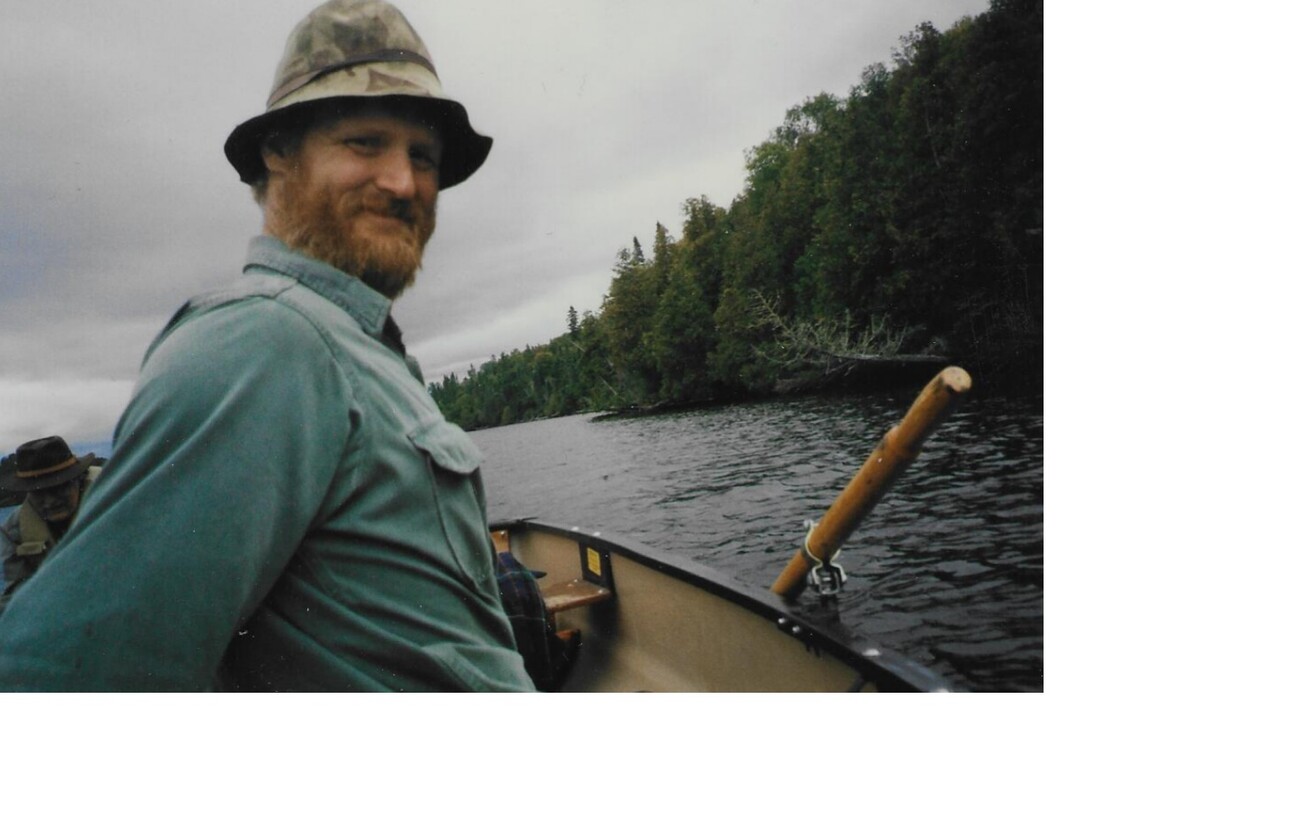
A much younger version of the author rowing his square stern canoe on Brule Lake in the BWCAW
Elk. Well, the promise of elk started this adventure. It was early June, a long time ago, and I was on my way to a wilderness lake in the Chequamagon National Forest when I stopped at the renowned Rondeaus store in Cable. Someone was selling raffle tickets to raise funds for reintroducing elk into northern Wisconsin. I figured it was a good cause, so I gave the guy some money, wrote my name down on the tickets, and promptly forgot about it. I did have a great time camping and fishing on the wilderness lake. In early September, I got a phone call from a guy asking me if I remembered buying tickets for something. I said no and wondered if it was a scam. He said no and added that I had won the square stern canoe, motor, and trailer. Then I remembered buying the tickets. Wow! We set a time for me to pick up the square stern canoe. After I hung up, I realized I didn’t even have a hitch on my car to haul the boat home from Cable.
Thus began a decades-long relationship with a 17-foot Old Town Discovery sport canoe. The dark green square stern canoe is a three-seater with oar locks set up for use in the center seat. The center width of the canoe is wider than most canoes. Also, the hull is not rounded. Instead, it has an irregular shape at the water line, which gives the canoe great primary stability. It's a canoe well-designed for fishing, hunting, and other outdoor activities on the water. It's also relatively lightweight and more or less easy to move over dry land to access remote areas.
The one feature of the boat I found of immediate interest was the oar locks. I had paddled canoes thousands of miles by the time I got this canoe, and had used outboard motors all my life, but I had never really owned a rowboat. As soon as possible, I outfitted the square stern with oars, plunked it into the waters of Lake Tainter and set out to row across the southern portion of the lake. I set out with a strong stroke of the oars and expected to zip right across the lake. Instead, the canoe insisted on going around in big circles. After about a half hour of rowing in circles, I managed to get back to shore. I decided to pull the canoe onto my yard and reflect on what just happened. A few days later, I went for another row in the canoe. I once again rowed around in circles despite trying everything I could think of to make the canoe go straight. However, this time the circles were greater in circumference than the first rowing session, so I took that as a sign of progress. The third time out, I managed to get across the lake and back. It is about a half a mile on a straight line across the lake from my starting point. I probably traveled three miles to complete that one-mile route out and back. I never traveled in a straight line, made a few circles, and generally wondered what kind of a defective boat I had won. I kept working on the rowing and found that rowing the boat was as subtle an art as paddling a canoe. I began to enjoy the rowing sessions as time went on, and I figured out the intricacies of rowing the square stern.
The square stern quickly became my go-to watercraft for duck hunting and for fishing, especially on the Chippewa River. One of my favorite places to duck hunt was where the Red Cedar River flows into Lake Tainter. The delta area holds lots of wetlands, which, of course, hold ducks. The put in spot was Champney Park. Back then, rowing from the put-in at the park to the wetlands was possible. One day, I let my daughters accompany me on the early morning hunt. Getting two elementary age kids out of bed and dressed well before first light was no mean feat, but we managed it. When we got to the park, the wind was perfectly still. The light of a fading moon provided surreal illumination, and a faint glow was starting to appear to the east. The water was an inky black color, and the cattails and other silhouettes of vegetation were a different shade of black. We could hear the splashes and night calls of the ducks as they paddled around the wetland. The birds roosting in the cattails began to make some soft morning calls. A flight of geese passed high overhead, honking to each other. The rhythmic splash of the oars melded with the other sounds of the morning as we traveled in a line from the landing to one of the branches of the Red Cedar flowing through the wetlands. (Yes, by this time, I had mastered the art of rowing the square stern in the direction I intended to travel.) We ascended the river a short ways, put out a few decoys, and waited for the daylight.
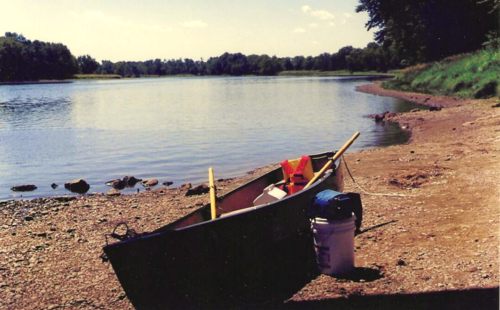
The Chippewa River is one of my favorite places to fish and canoe. The square stern with its motor and oar combination, and shallow draft, has proven to be an ideal watercraft for navigating the Chippewa with its many sandbars, rock bars, and submerged trees.
On one memorable trip, I camped on an island situated towards the upstream end of the Tiffany Bottoms Wildlife Area. I found a small anchorage on the downstream end of the island and set up camp in the late afternoon. I then cleaned and cooked a couple of walleyes I had caught while on my way to the island. It was a true 5 Star dining experience. The next morning, I got up at first light and motored my way downstream, stopping to fish some promising-looking spots. Skipjacks and bass were brought into the square stern. The boat landing immediately upstream from the Highway 35 bridge was a great place to get out, stretch my legs, and have a bit of lunch.
My next stop was the confluence of the Chippewa and Mississippi rivers. The delta of the Chippewa forms the downstream end of Lake Pepin. The channel flowing out of Lake Pepin is relatively narrow, so the current is both fast and powerful. I cruised around the confluence for a bit, and then found a promising spot to drop anchor and do some jigging. After a little while, I pulled up the anchor and headed upstream to my camp. Back at camp, I built a fire, cooked the few fish I had kept for supper, and watched the sun set. The next morning, I had to mix up some more gas and oil before heading upstream. I ran upriver past Durand to the lower end of Nile Mile Island. At this time, the upstream end of the west channel around Nine Mile Island was mostly closed, so the channel was a slough rather than an active flowing river. I anchored just inside the slough and fished near the current line. I hooked into a big fish, which I fought for a long time. When I finally got it to the square stern, it was a very large dogfish. It was promptly returned to the river. One fun aspect of fishing the Chippewa is the wide variety of fish. You never really know what kind of fish is on your line until you get up to the boat. A group of jet skiers came upriver and began to drive in circles when they saw the split river at the base of Nine Mile Island. Eventually, two jet skiers cruised up to me and asked if I knew which way to go to get to Eau Claire. I pointed upstream and told them to always follow the current, and they would be good. Soon, it was time to pack up camp, so I headed back downriver to my camp. Loaded everything up and headed to the landing at Ella.
The mighty square stern has been on many adventures. It went on multiple trips to the Boundary Waters, including a memorable trip with my dad and daughters. The trip was their second Boundary Waters trip. They were five and six years old. It was a no-portage trip. We camped on a large island on Brule Lake and had a lot of fun rowing around the lake. The square stern even allowed us to watch the 4th of July fireworks from Lake Menomin on multiple years. That small donation towards elk restoration, plus a lot of luck, resulted in a plethora of adventures. Now, if only the elk that I helped bring back would be more cooperative and appear when I am in the North Woods.
Memberships


Add new comment