
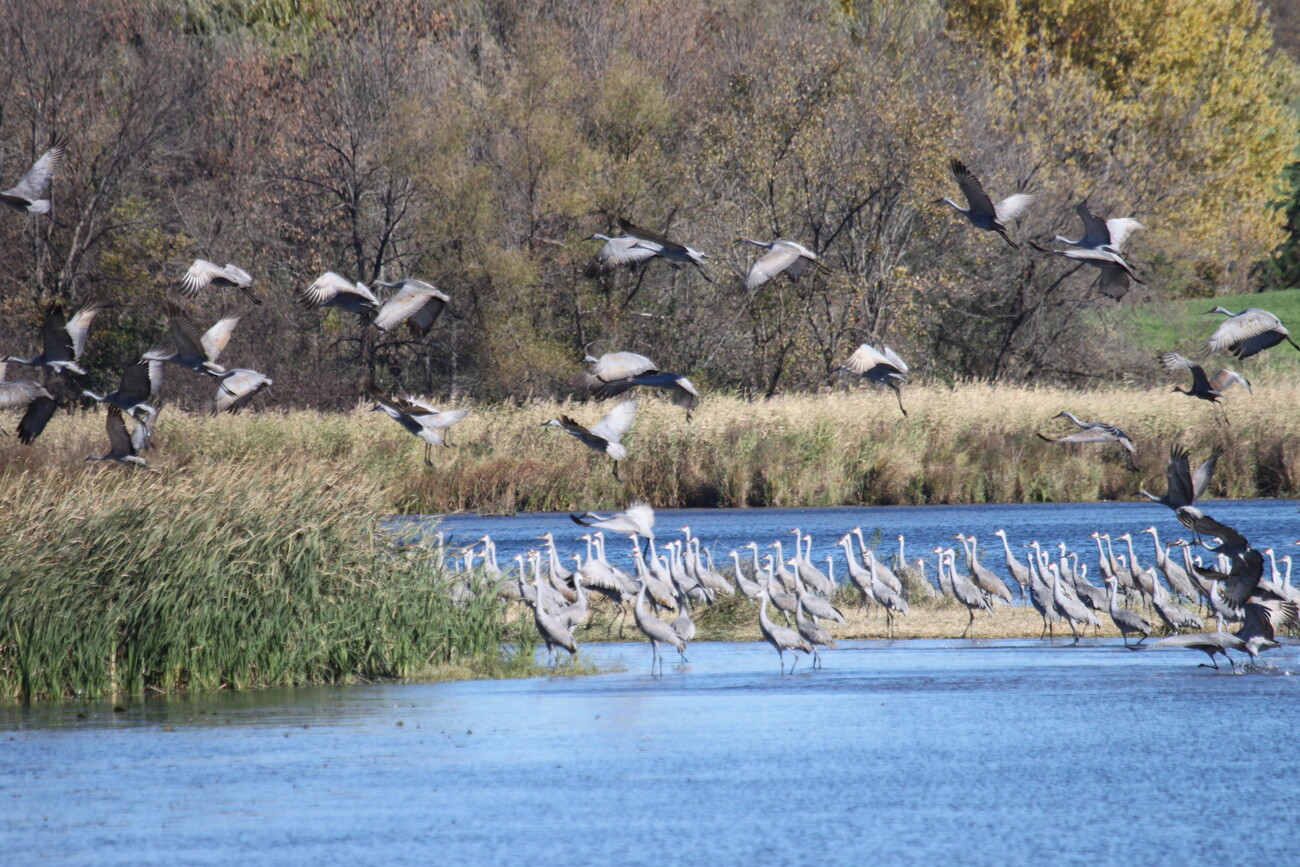
Sandhills taking flight
The fall bird migration season is at its height. For birders, it's like the entire winter holiday season wrapped up into a few wonderful weeks. Millions of birds are heading south from northern climes to warmer lands to the South. Some bird species will travel from the furthest northern reaches of North America to the extreme southern tip of South America. Other bird species will end up along the Ohio River Valley, while most species will spend their winter near or on the coast of the Gulf of Mexico. Fall birding can be more challenging than spring birding since many of the birds, especially smaller songbirds, have lost their bright and distinctive breeding season plumage and are more nondescript. Fortunately, though it is easier now than at any time to become a successful birder, and Dunn County and its nearby environs offer a plethora of prime birding locations.
Unlike most outdoor activities, no major equipment purchases are needed to start birding. One new tool that allows anyone to go into the field and ID birds is the app Merlin [https://www.birds.cornell.edu/home/]. The app is free and was created by the Cornell Lab of Ornithology, and has two primary means of identifying birds: by sound or photo. I primarily use the sound ID feature. When I am camping and a chorus of birds is sounding off in the morning, I open Merlin and let it ID the birds while I am heating tea water. To use the photo feature, just take a photo of a bird and open the photo feature to submit the photo. Merlin does not ID birds 100 percent of the time, but its 99 percent better than I can do. In addition to the identification features, Merlin has a comprehensive library on birds. When a bird is identified, users can click on the bird and read extensive information on the bird’s appearance, calls, habits, and habitat. Merlin is a great tool to learn about birds and how to identify them. Merlin is the perfect tool for the beginner to help them develop into an expert birder who can ID birds without the help of an app. Merlin is also a citizen science project, so every time a user submits bird IDs to Merlin, they are adding to an extensive worldwide database on birds.
Bird Cast [https://birdcast.info/migration-tools/live-migration-maps/ ] is a free on-line resource that shows in real time where and what species of birds are migrating. Bird Cast is designed to be much like a weather forecast map. Bird Cast states, “Bird migration forecasts show predicted nocturnal migration 3 hours after local sunset and are updated every 6 hours. These forecasts come from models trained on the last 23 years of bird movements in the atmosphere as detected by the US NEXRAD weather surveillance radar network.” Bird Cast describes the live migration maps as, “Real-time analysis maps (that) show intensities of actual nocturnal bird migration as detected by the US weather surveillance radar network between local sunset to sunrise. All graphics are relative to the Eastern time zone.” Bird Cast maps can tell birders when is the prime time to head out. Bird Cast is a partnership between the Cornell Lab, Colorado State University, and UMass Amherst.
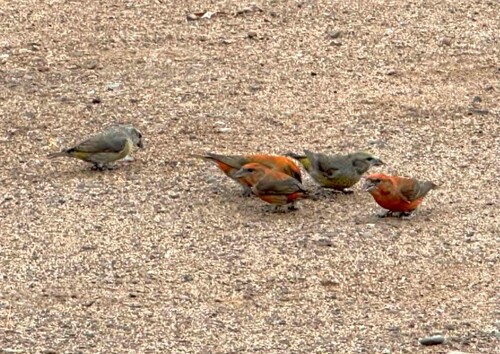
Red Crossbills feeding for the next leg of their journey south
All that is really needed for novice birder to get started is a cell phone with Merlin loaded on it and a place to look for birds. Dedicated birders may have a high quality set of binoculars to make bird identification easier. They may also have a good digital camera with a powerful telephoto lens that can take a close up of a humming bird’s beak at a 1000 yards, OK, maybe not a 1000 yards but 50 to 100 yards. There are many great birding guides that make excellent reading/study material for the winter months. The birding guides are also useful tools when in the field looking for birds. One of the best ways to improve birding skills is to go birding with a veteran birder. Watch, listen, and learn from the veteran birder. It's also a good idea to buy them lunch so they will bring you along on other future birding trips.
Now we have the tools needed to identify birds and the knowledge of when birds are migrating, so where do we find them? Fortunately, Dunn County has many places to look for birds. One of the most accessible spots is the Red Cedar Trail. Eagles, ducks, geese, and songbirds, such as juncos, chickadees, and cedar waxwings, are all common visitors to the river and trail. At its southern end, the Red Cedar Trail traverses Dunnville Bottoms State Wildlife Area. The habitat in this 6000 acre wildlife area is very diverse and consequently attracts a wide variety of birds in the fall. Numerous parking areas are located on County Y and the multiple roads that enter the Bottoms from County Y. One birding behavior I have seen for numerous years here is in September, when robins abandon the urban habitats, but rather than immediately flying south, they congregate in river bottoms like Dunnville and forage among the forest duff. A flock of robins working over a section of river bottoms can make a lot of noise.
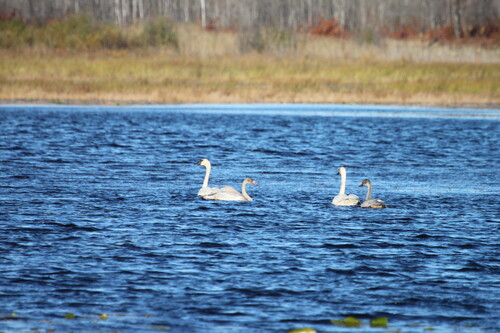
Swans on the Pond
Menomin Park which is sometimes called 3M Park is on Menomonie's far east side and is a popular spot for birding. The park sits on the eastern shore of Lake Menomin and has both wooded and prairie habitat. Once again, diverse habitat means a greater variety of birds.
The Red Cedar Preserve and Rec Area just north of Colfax is a good birding location. The Area has many walking trails that make it easy to move about while spotting our feathered infatuations. The Preserve and Rec area was recently created and is still undergoing habitat improvements. It's a great place to visit.
A backyard can be an everyday birding paradise. The simplest way to attract birds to your backyard is to have several feeders with different types of bird food. As the summer abundance fades away with the onset of Autumn, birds will flock to feeders. Once a feeder is established it is important to keep it full of food for the birds. Over the long term, homeowners can plant bird-friendly flora to attract and hold birds in the yard.
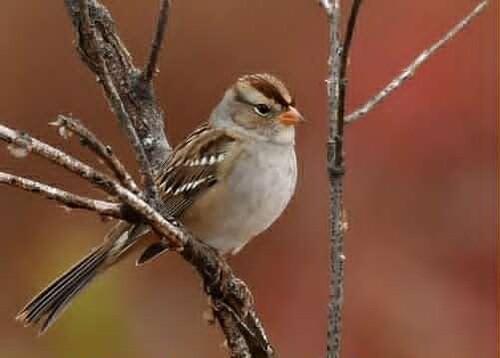
White Crowned Sparrow taking a break
If combining a fall drive with some birding sounds attractive, there are many destinations within a one-hour drive of Dunn County. The Mississippi River is, obviously, the central feature of the Mississippi Flyway, which millions of birds follow during migration season. Two famous spots for bird watching are Reicks Lake Park and Weaver Bottoms. Reicks Lake Park is located a mile or so north of Alma on highway 35. It's a small park sandwiched between the highway and a large wetland lake formed by the Buffalo River as it runs into the Mississippi River. The park has a very nice observation deck overlooking the wetlands. Weaver Bottoms is a 5000 acre wetland located on the Minnesota side of the river, approximately 12 miles south of the crossing between Nelson and Wabasha. It can be accessed at a boat landing that is immediately off Highway 61. Paddling a canoe or kayak is the best method for touring the open waters of the Bottoms. Massive numbers of waterfowl use these two areas as a stopover on their flight south. In addition to the usual geese and ducks, tundra swans and sandhill cranes are commonly viewed at both Weaver Bottoms and Reicks Lake. Eagles and other raptors also migrate in large numbers on the Flyway. As winter sets in, eagles will begin to congregate near the Nelson-Wabasha area and may be viewed by the dozens.
With the birds being on the move and the great fall weather that has been occurring, it is prime time to get outside and begin to compiling a birding life list or add to your birding life list.
Memberships


Add new comment