
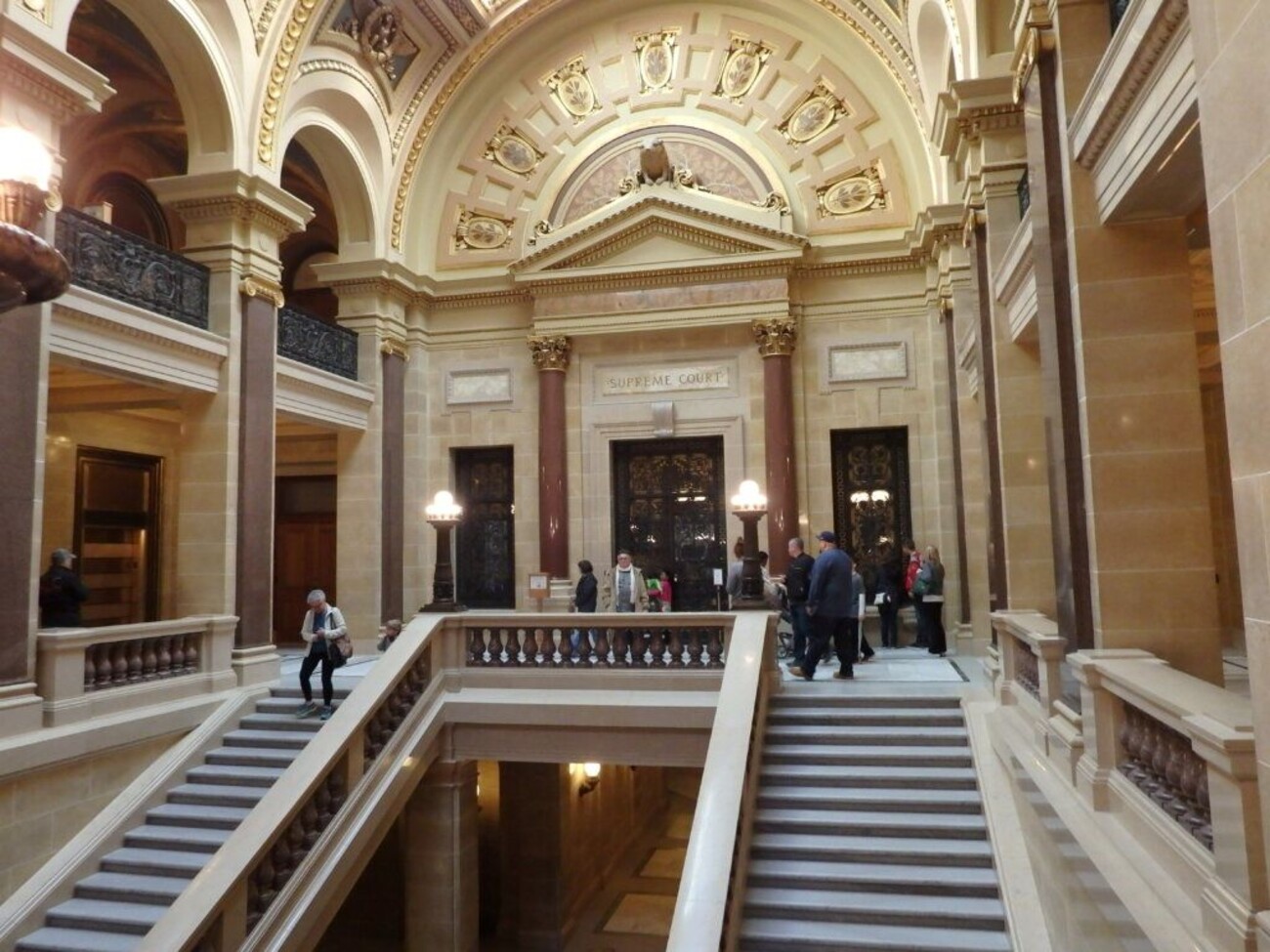
Photo by Mike Steele | Flickr CC BY 2.0
The conservative legal outfit Wisconsin Institute for Law & Liberty (WILL) is once again urging the Wisconsin Supreme Court to take control of drawing the state’s political maps.
But the best arguments against doing so have come from none other than the conservative justices on the Wisconsin Supreme Court itself.
Despite being rebuffed a few months ago in a similar effort on redistricting, WILL president and general counsel Rick Esenberg is arguing that “adopting new legislative maps is a state responsibility. If the Legislature and governor cannot agree, it is entirely appropriate — even necessary — for the Wisconsin Supreme Court, a branch of state government, to pass a judicial apportionment plan.”
What Esenberg doesn’t say in his latest petition to the Supreme Court is that Republicans desperately want to hold onto the advantage they have under the current, gerrymandered maps that allowed them to keep control of both houses of the Legislature even when a majority of votes statewide went to Democrats. No doubt legislative Republicans, whose causes Esenberg frequently champions, figure they have a better shot at keeping control if the 4-3 conservative majority on the state court — elected with Republican support — draws the new maps instead of federal judges serving lifetime appointments or a neutral, nonpartisan commission.
Esenberg expressed shock and outrage at the suggestion that giving the Supreme Court the power to draw the maps would benefit Republicans. It is an “insult to the courts to suggest that they are inherently partisan” he declared on Capital City Sunday on WKOW, Madison’s ABC affiliate.
But over and over again, including after conducting an exhaustive, multi-year study, the justices have rejected the notion that the state Supreme Court is the proper forum for drawing political maps —precisely because doing so would drag them into partisan politics
In May, when Esenberg made his last argument that responsibility for drawing a new map rests with the Supreme Court, Chief Justice Patience Roggensack interrupted him to explain that the court was not set up for map-drawing.
“Counsel, we do cases and controversies,” Roggensack said. “What your rule does is it permits this court to draw the lines.”
Jeffrey Mandell, founder of the progressive legal group Law Forward, expanded on that point in a debate with Esenberg on Capital City Sunday, explaining why the court has rightly rejected the idea that it should take on map-drawing.
Our court is pushed on enough politically
– Wisconsin Supreme Court Chief Justice Patience Roggensack
One of the first questions the Supreme Court asks when deciding whether to take any case, Mandell explained, is whether it presents pure questions of law or whether there are a lot of facts that need to be decided. “There is no witness box in the Supreme Court courtroom,” he pointed out. And redistricting is based entirely on facts, involving “a lot of complexity, analysis, experts and fact-finding.”
Back in 2008, at a hearing on adopting a rule for redistricting legislation, Roggensack declared, “Redistricting is inherently political. And I think, frankly, our court is pushed on enough politically.”
Conservative Justice Annette Ziegler similarly expressed concern about adopting a rule giving the court jurisdiction over redistricting, saying, “We have to be very careful not to look as if we have decided (a) we would take such a case, (b) we’re better suited to take the case, or (c) we know how you figure out such a case.”
The late conservative Justice David Prosser announced at the same hearing that he would, “vote against [taking an original action] every time. … Let them go to the federal court.”
In 2009, after studying the issue in committee for years following the 2000 census, a majority on the court voted in favor of Roggensack’s motion to abandon the process of attempting to create procedural rules on redistricting legislation.
At the 2009 administrative conference in which they made that decision, Roggensack said that such rules had the potential to violate the separation of powers, pushing the court beyond interpreting the law and forcing it to “insert ourselves into the actual lawmaking function.”
GET THE MORNING HEADLINES DELIVERED TO YOUR INBOX
Contrary to Esenberg’s recent protest that it is an “insult” to the court to suggest that it might be viewed as partisan, Roggesack objected that creating a rule that got the court involved in the redistricting process early had the potential “to increase the political pressures on this court in a partisan way that is totally inconsistent with our jobs as nonpartisan judiciary.”
Ziegler put it even more strongly: “I’m concerned about the court acting kind of as a super-legislature,” she said.
“I’m concerned with the idea that it places this court or the court of appeals squarely within the sights of the partisan political framework,” she added. “We have a federal court who has lifetime appointments and they have done this three times and apparently have done it successfully.”
Too partisan for Michael Gableman
Even former Supreme Court Justice Michael Gableman, who is currently leading GOP Assembly Speaker Robin Vos’ dubious and highly political audit of the 2020 presidential election results, expressed his concern at the time that getting involved in redistricting would politicize the court.
Gableman warned that “to allow ourselves at this point to create that avenue by which we will be immersed in the partisan political process would be a mistake.”
Nothing has changed since all those conservative justices rejected involving themselves in redistricting, except that now, with the results of the 2020 census in, Republicans in the Legislature are searching for a way to hold onto power by making an end run around the regular process.
“When the issue of the state high court deciding redistricting cases was debated over a decade ago, conservative justices, including two who are on the bench today, were unequivocal in their alarm at the danger of politicizing the court,” says Mike Browne, deputy director of the progressive group A Better Wisconsin Together. “As we’ve watched Republicans and the right wing bring political cases to the court again and again over the last several years that danger has only grown. It was a bad idea over a decade ago, it’s a worse idea now.”
Voting rights groups have already gone to federal court to argue that the feds, not the elected state court, should take up the problem of drawing the map if the Legislature and Gov. Tony Evers cannot agree.
Esenberg, who has represented GOP legislative leaders in their efforts to seize power from Evers and led the effort to purge Wisconsin’s voter rolls, insists that it’s a matter of constitutional importance that the state court keep control of the redistricting process. Never mind the long history of federal courts intervening to decide the maps when legislators and governors of different parties couldn’t agree.
“There is not a single time in my entire life that the Wisconsin Supreme Court has decided the maps,” Mandell said in his debate with Esenberg on Capital City Sunday.
Esenberg replied, jokingly, “Jeff is a young man.”
But the precedent stretching back to the early 1960s has been good enough for the conservatives on the court.
“The federal courts have done a very good job, and the federal courts are not elected officials that are apt to be seen as partisans when they do the job of redistricting,” Roggensack said in 2009.
Meanwhile, while the Legislature has yet to publicly release a new map, there are two more redistricting lawsuits already pending in federal court brought by voting rights advocates and Democrats.
One of these, brought by Black Leaders Organizing for Communities, Voces de la Frontera, the League of Women Voters of Wisconsin and three voters, asks the federal court to prepare to intervene, as it has in the past, if the Legislature and the governor can’t agree on a map.
Republicans want the federal court to dismiss the case brought by Democrats, which argues that Wisconsin’s current maps are unconstitutional, and therefore the Legislature should not be allowed to use them as the basis for drawing new maps.
The Republicans call that suit “wildly premature,” even as they jockey for their own political advantage.
All of this politicking is exactly what the Wisconsin Supreme Court justices have tried to avoid.
As former Justice Prosser put it: “I don’t see how I can possibly vote for a plan that puts this court right in the middle of reapportionment and almost encourages us to be a part of it.”
Wisconsin Examiner is part of States Newsroom, a network of news bureaus supported by grants and a coalition of donors as a 501c(3) public charity. Wisconsin Examiner maintains editorial independence. Contact Editor Ruth Conniff for questions: [email protected]. Follow Wisconsin Examiner on Facebook and Twitter.
Memberships
Prosser tells GOP:' Keep me on the court to rule on union-busting'
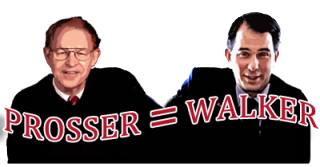 Supreme Court Justice David Prosser says he is "about 100%" sure that Gov. Scott Walker's union-busting budget review bill will come before his court -- and while not coming out and saying how he'd rule (wink, wink), he's telling Republicans they should support him because his opponent would rule against Walker.
In a video interview for the Dane County Republican Party, Prosser, a former GOP legislator, also warns that redistricting is likely to come before the court, and he and his conservative colleagues "don't want any part of legislative redistricting."
This is the same guy whose campaign said he wants to "complement" the work of Walker and the GOP legislature, because his views "closely mirror" Walker's.
From the interview:
HOST: Okay. Right now we’re facing huge protests against the budget repair bill here in Wisconsin which is setting quite a precedent in the country. What are the chances that that would go to the Supreme Court, that bill.
PROSSER: I would say about 100 percent.
HOST: Really?
PROSSER: I would think that there’s going to be champ—I’m sure there’s going to be litigation on the Court and in fact, I think part of the effort against me in the campaign is to replace me on the Court in the event this bill and other legislation passed by the new governor and legislature are litigated. I think that they want someone on the Court who will be an almost automatic vote against anything that comes out of the new legislature.
HOST: Is that right?
PROSSER: Oh, yes. I think that there’s no question at all as I’ve talked to people that part of the motivation for the candidates running against me is to have a block of four people who will reapportion the legislature along more liberal lines whereas the conservative members of the Court don’t want any part of legislative redistricting.
Prosser, of course, has no idea what the grounds for a redistricting case might be, he seems to be prejudging any redistricting case that might be brought before the court, regardless of the merits. He wants to leave it up to the Republican governor and the Republican legislature. No need for that third branch of government to get involved, is there?
Back to the interview, where Prosser tries to cover his tracks at the end:
HOST: Because we need you on the court, we need you.
PROSSER: Well, I appreciate that.
HOST: I mean, well, it’s a fact especially if this budget repair bill as you say definitely going to be coming out on the Supreme Court for a vote.
PROSSER: Wha—you’re question to me was did I think it was going to be litigated. I am certain it is going to be litigated. I don’t want to take the position that I prejudged anything that is going to be litigated. No, I’m not saying I’m committed one way or the other but if I had to bet whether the bill would be litigated, I’d put a lot of money on that.
And he'd put a lot of money on the fact that the Republicans would like his position a lot better than his opponent's, Joanne Kloppenburg. And he's not saying how he'd rule? If anyone can't figure it out after watching the interview, let me know.
Prosser is a frequent practitioner of the wink and a nod school of campaigning. Here's an excerpt from an interview he did with Northwoods Patriot Radio (sort of like the League of Women Voters, only different):
STEVE: It is for sure and another thing that I’d like to point out that’s quite interesting, in the upcoming race for Supreme Court is that Justice Prosser is a pro-life candidate and the three opponents that he’s running against are not pro-life, so … I take it, Justice Prosser, that you hold life dearly and you believe that that is not something that is not to be messed with.
PROSSER: Well, Steve, I have to be very careful what I say because I cannot commit myself, I, as a judge …
STEVE: I understand.
KIM: Yeah.
PROSSER: In deciding a case in a particular way. On the other hand, people can look at what I’ve done over a lifetime and kind of read between the lines.
Your witness.

Press releases and other content not written by a specific Eye On Dunn County author are listed as Eye On Dunn County Staff.


Add new comment