
The Lawyers’ Committee filed an Amicus Brief in the Landmark Redistricting Case
Washington, D.C. – Today, Kristen Clarke, president and executive director of the Lawyers’ Committee for Civil Rights Under Law, delivered remarks at the Rally to End Partisan Gerrymandering in front of the U.S. Supreme Court, during oral arguments in Gill v. Whitford. The Lawyers’ Committee filed an amicus curiae or “friend of the court” brief in this complicated case challenging the 2011 Wisconsin State Assembly redistricting plan, which brings to the forefront important questions regarding electoral map making and the ability of voters to have an influence in their representation. In Wisconsin, the redistricting map was struck down by a three-judge federal court panel for imposing “burdens on the representational rights of Democratic voters” in gerrymandered districts. While the Supreme Court has ruled that racial gerrymandering is unconstitutional, it has not provided clear guidance regarding partisan gerrymandering.
Clarke, who attended today’s hearing, made the following statement:
“While some of the Justices expressed concern about the floodgates of litigation opening, other Justices were focused on the measurable threat presented by gerrymandering and its impact on the integrity of American democracy. It is time for the Court to act now and rule unequivocally that cases of extreme partisan gerrymandering are subject to judicial review. Gill v. Whitford is a clear example of an electoral map drawn by one party in control of its state legislature in a way that maximizes its partisan advantage. The extreme partisanship at issue in Gill v. Whitford presents strong facts for the Court to provide rules that can help guide the efforts of lawmakers. This case is particularly important as a ruling may provide needed clarity for lawmakers as they prepare for the 2020 redistricting cycle.”
In considering a remedy to address partisan gerrymandering, the Lawyers’ Committee filed an amicus brief. The brief, filed with the Georgia State Conference of the NAACP, highlights a racial and partisan gerrymandering case filed by the Lawyers’ Committee this year in Georgia. In that case, plaintiffs claim that the redrawing of lines for Georgia House of Representatives Districts 105 and 111, in 2015, was done with a racially discriminatory purpose to favor the election of white incumbents. In considering a remedy for partisan gerrymandering, the Lawyers’ Committee brief urges the Supreme Court to adopt a standard applicable to partisan gerrymandering sufficiently flexible so as to apply to cases like the Georgia case.
Click here to read the Gill v. Whitford amicus brief filed in the United States Supreme Court by the Lawyers’ Committee for Civil Rights Under Law.
About the Lawyers’ Committee for Civil Rights Under Law:
The Lawyers’ Committee for Civil Rights Under Law, a nonpartisan, nonprofit organization, was formed in 1963 at the request of President John F. Kennedy to involve the private bar in providing legal services to address racial discrimination. Now in its 54th year, the Lawyers’ Committee for Civil Rights Under Law is continuing its quest “Move America Toward Justice.” The principal mission of the Lawyers’ Committee for Civil Rights Under Law is to secure, through the rule of law, equal justice for all, particularly in the areas of criminal justice, fair housing and community development, economic justice, educational opportunities, and voting rights.
Contact:
Derrick Robinson
Links
Memberships
Gill v. Whitford Oral Arguments at Supreme Court today

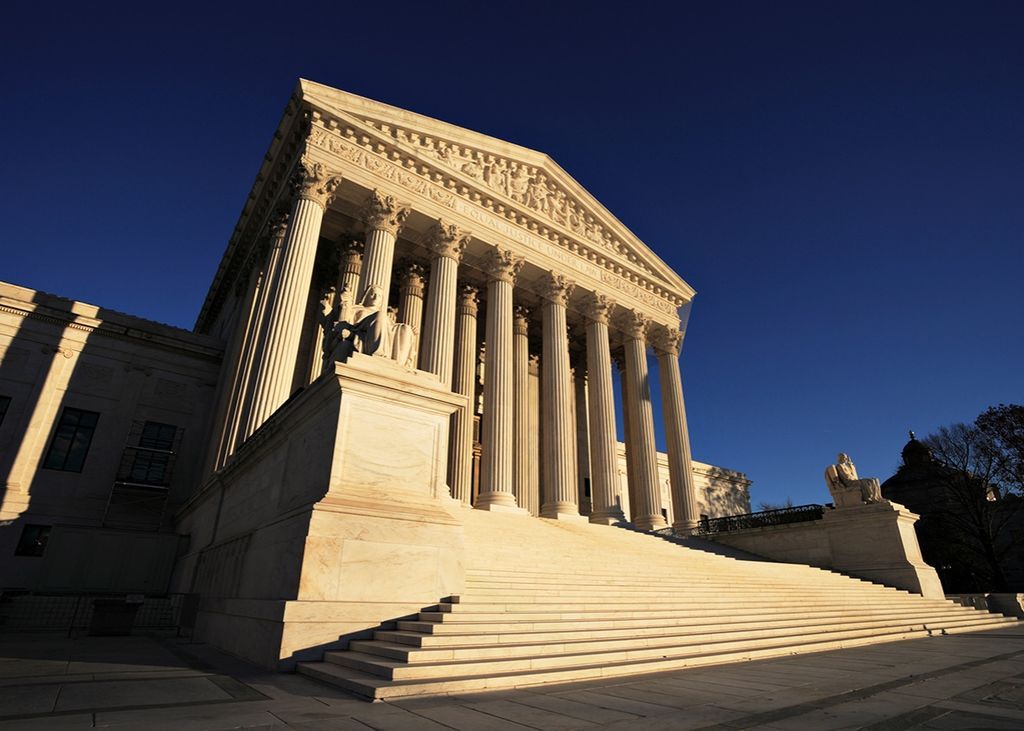
Oral arguments are being heard today at the U.S. Supreme Court in the Gill v. Whitford case. I hear you asking yourself "why do I care?".
Gerrymandering is the practice of drawing political boundaries with the intention of influencing the outcome of elections. This happens all the time, and has eventually over the years become accepted legally. However, as with many things in Wisconsin, the last few years have seen this practice being carried to an extreme. The Supreme Court has in the past indicated that they might be willing to hear an argument against gerrymandering of districts if there was a way to attach a practical measure of how the method of drawing the districts causes an influence on the outcome of elections.
Gill v. Whitford is intended to be that case. I will not go into the math involved (though it's not that complicated) and simply say that a measure has been made of how unfair legislative districts are, and Wisconsin is by this measure an extreme case. In general it means that the winners of elections across the state do not reflect the opinion of the electorate, but is influenced by how the districts have been drawn. In general terms this amounts to arranging the districts in such a way that a small number of districts are made safe for the opposing party, while making a larger number of districts safe for the party in power, which has drawn the maps.
Lower courts have ruled that the legislative districting in Wisconsin is unfair, and the state has been required to re-draw the maps in a fair manner. All of this has been held up as the case has gone to appeal with the federal Supreme Court. The fairness of elections in Wisconsin is at stake, and indeed this could influence the fairness of elections across the country. It is an extremely important case. This video will help to explain what has been going on, and the timeline of the case up until today.

Steve is a member of LION Publishers , the Wisconsin Newspaper Association, the Menomonie Area Chamber of Commerce, the Online News Association, and the Local Media Consortium, and is active in Health Dunn Right.
He has been a computer guy most of his life but has published a political blog, a discussion website, and now Eye On Dunn County.


Add new comment