
Irfan Khan / Los Angeles Times via Getty Images
James D. McCalley, Iowa State University
Many kinds of extreme events can disrupt electricity service, including hurricanes, earthquakes, floods, wildfires, extreme heat, extreme cold and extended droughts. Major disasters can leave thousands of people in the dark. The Texas deep freeze in February knocked out 40% of the state’s electric generating capacity.
During such events, unaffected regions may have power to spare. For example, during the February blackouts in Texas, utilities were generating electricity from hydropower in the Pacific Northwest, natural gas in the Northeast, wind on the northern Plains and solar power in the Southwest.
Today it’s not possible to move electricity seamlessly from one end of the U.S. to the other. But over the past decade, researchers at national laboratories and universities have been working closely with industry engineers to design an interstate electricity system that can. And President Biden’s infrastructure plan would move in this direction by allocating billions of dollars to build high-voltage transmission lines that can “move cheaper, cleaner electricity to where it is needed most.”
My engineering research focuses on electric power systems. At Iowa State University we have worked to quantify the benefits that macrogrids can bring to the U.S. These high-capacity transmission systems interconnect energy resources and areas of high electricity demand, known as load centers, across large geographic regions.
A national highway system for electricity
Dwight Eisenhower had been thinking about a national interstate highway system for decades before he was inaugurated as president in 1953. Eisenhower argued that such a system was “as necessary to defense as it is to our national economy and personal safety.”
Congress agreed and passed the Federal-Aid Highway Act of 1956, which authorized the federal government to pay 90% of the cost of this US$114 billion system, with states covering the rest.
Eisenhower was worried about evacuating cities in the event of nuclear war. The security argument for a macrogrid focuses on extreme events that disrupt the power grid. And the economic argument centers on moving wind, solar and hydro power from areas where they are plentiful to areas with high power demand.
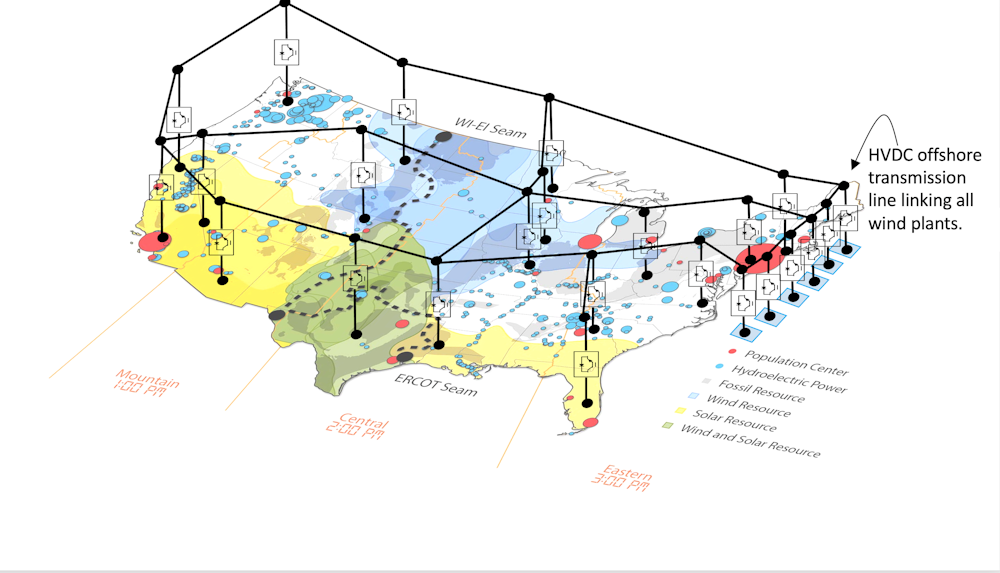
Today the North American power grid is actually five grids, also known as interconnections. Two large ones, the Eastern and Western Interconnects, cover most of the lower 48 states and large swaths of Canada, while three smaller grids serve Texas, Alaska and northern Quebec. Each of these grids uses alternating current, or AC, to move electricity from generators to customers.
The Eastern, Western and Texas Interconnects are linked by high-voltage direct current, or HVDC, lines that make it possible to transmit power between them. These facilities are aging and can only transfer small quantities of electricity between grids. One way to think of a macrogrid is as an overlay that pulls together the existing U.S. grids and makes it easier to move power between them.
James McCalley, CC BY-ND
Sharing power across regions
President Biden has proposed sweeping action to achieve a clean energy transition in the U.S., including making electric power carbon-free by 2035. This will require adding a lot of new renewable generating capacity over the next 15 years.
Wind and solar costs have fallen dramatically in recent years. Today power from new, large-scale wind or solar plants is cheaper than electricity from existing coal plants. Yet, renewables provide only about 21% of U.S. electricity.
A macrogrid would reduce the cost of electricity from new wind and solar plants in two ways. First, it would enable high-quality renewable power – mainly Midwestern wind and Southern solar, and potentially Canadian hydropower – to supply coastal load centers. It is cheaper to build transmission systems that can move this power over long distances than to generate it from lower-quality, weaker Sun and wind resources closer to cities.
Second, a macrogrid would make it possible to share energy production and grid services between regions. This strategy takes advantage of time differences due to time zones and the fact that electricity demand tends to peak at certain times of day, such as when people arrive home in the evening. And electricity prices rise and fall during the day with demand.
For example, at 3 p.m. Pacific Time, power demand is relatively low on the West Coast, which means the cost of that electricity is also low. Excess Western electricity could be used to supply demand on the East Coast, which peaks daily simultaneous with this 3 p.m. West coast “low” which occurs at 6 p.m. Eastern Time. Four hours later, when the West Coast hits its 7 p.m. Pacific Time daily peak, it would be 10 p.m. on the East Coast, which would have extra generation to share westward.
Capacity sharing also works because annual peak power demand occurs at different times of year for different regions. Each region is required to have access to enough generation capacity to meet its annual peak load, with some margin to cover generation failures. A macrogrid would enable regions to share excess generating capacity when it’s not needed locally.
This strategy provides benefits even when annual peaks in two regions differ by only a few days. When they differ by weeks or months, the payoff can be large. For example, power demand in the Pacific Northwest typically peaks in winter, so the region could borrow capacity from the Southwest and Midwest, where demand peaks in summer, and vice versa.
Building transmission saves money
In a study that I published in 2020 with academic and industry colleagues, we showed that without a macrogrid it would cost more than $2.2 trillion from 2024 through 2038 to develop and operate the nation’s electric power system and achieve 50% renewable power generation in 2038. This includes the costs of adding 600 gigawatts of new generating capacity that would be almost entirely wind and solar; operating costs for remaining fossil and nuclear power plants; and building new AC transmission lines to connect new power plants to customers.
However, we calculated that if the U.S. spent $50 billion to develop a macrogrid, the total long-term cost of developing and operating the nation’s electric power system and achieving 50% renewable electricity in 2038 would decrease by more than $50 billion. In other words, by making it possible to share power across regions and deliver high-quality renewable power from remote areas to load centers, the macrogrid would more than pay for itself.
Some observers may worry that a nationally connected grid would be more vulnerable to cascading blackouts than our existing system. In fact, a macrogrid would actually be more reliable because HVDC provides increased grid control capability through its flexible converter stations.
Industry leaders and clean energy advocates are calling for the U.S. to pursue macrogrid development. But North America is lagging behind most of the world in developing interregional power lines to tap low-cost clean energy resources. And if $50 billion seems like a big investment, consider this: It’s also the estimated minimum cost of outages and energy price spikes during the Texas deep freeze.
[You’re smart and curious about the world. So are The Conversation’s authors and editors. You can get our highlights each weekend.]

James D. McCalley, Professor of Electrical Engineering, Iowa State University
This article is republished from The Conversation under a Creative Commons license. Read the original article.
Memberships
Walker: Math-challenged on school cuts
[img_assist|nid=49419|title=Walker-based education|desc=|link=none|align=left|width=120|height=135]What with all his non-factual, rhetorical flourishes like "tools" and "dynamic" and "bold" and "we're broke," it's sometimes hard to keep a sensible perspective about Gov. Scott Walker's agenda. But let's try to do the math, even though Walker himself likely would prefer we not.
And the math boils down to this: Walker's proposals statewide average out to cuts of $1449 per public school pupil.
Here's how I arrived at that figure, which I have not seen reported in any popular media:
First, in the name of balancing the state budget, Walker would strip $835 million from state aid to pubilc schools. There are 879,825 public school students in the state. Divide the cuts by the number of pupils and this one step will represent a loss of $949, on average, for each public school student in Wisconsin.
But wait, there's more. Walker also would reduce public school district property-tax authority by an average of $550 per pupil – a move that makes it more difficult for schools to compensate for that lost $949.
Add up the cuts in state education aids and his effective forced reduction in revenue via local property taxes and the total is $1,449 per public school pupil.
According to the Wisconsin Department of Public Instruction , the average cost for educating a student in Wisconsin is $10,549 per student per year. Walker's initiatives are in a two-year budget, so halve the dollar amount of his cuts and they represent nearly a 7 percent annual spending reduction per pupil.
What's a public school pupil worth? Almost $1,500 less than we think, according to Walker.
Now, if school districts can figure out how to make up all or some of that lost revenue by cutting spending -- say for instance by whacking teacher salaries, as another Walker "tool" would make almost mandatory -- then the loss in education funding wouldn't be as severe. And surely there is more to teaching than money. So say conservatives who nevertheless have grabbed big chunks of cash from Milwaukee Public Schools in order to enable their vision of private, tuitiion schools that run like competitive businesses, and for a profit.
But there's no way around it: Walker wants public schools to do with less. A lot less. And if you think, like he pretends to think, that this will improve public education in Wisconsin, you need to attend a remedial math class.
Naturally, some school districts stand at risk of losing less than that $1,500 amount. But others could lose more. A lot more, in the case of Milwaukee Public Schools.
Indeed, MPS also stands to lose more money through the private school voucher program Walker proposes to expand, enabling even some wealthy city residents to send their kids to pricey private schools outside the city, and at a fat subsidy from already beleagured city taxpayers. Currently, the private school voucher program pays a subsidy of $6,442 per pupil, money that MPS is made to cough up without recompense. Last week the legislature's budget-writing Joint Finance Committee approved a Walker measuree bill that eliminates the cap on students enrolled in the program, and makes it possible for much wealthier families to take advantage of the vouchers to move their kids out of MPS.
The cap is currently 22,500 students. MPS pays for all the subsidies, at the expense of revenue intended for its own students. That's not part of the nearly $1,500 Walkernomics would take from the system. MPS would have to pay for more for the voucher program yet the governor and legislature continue to refuse to offset a dime of these expenditures. Thus the hit to Milwaukee is greater than just the cut in state school aids and cap on property taxes. It's an additional unfunded mandate that will constrain MPS yet some more. This from Walker, a Republican who professes to hate unfunded mandates. Except when he doesn't.
In sum, the Walker view is that pubilc school pupils should get $1,500 less -- and then some -- but an increasing number of private school pupils should get multiples of that in further Milwaukee public tax dollars going to vouchers. And get it regardless of how much their parents are worth. Can you say "upward redistribution of wealth," boys and girls?
And all this because, according to Walker, private schools introduce "competition" into the school "marketplace" and that will magically make pubilc schools better. If it doesn't kill them first. Good old Grampy Walker and his homespun remedies! Feed a cold (that would be voucher schools) and starve a fever (that would be Milwaukee Public Schools). Never mind studies showing that voucher schools don't produce kids who are noticeably better educated. Gotta crack the whip on those "failing" public schools! Oh, and also remember: Pubilc, unionized teachers are thugs.
Thanks to our college-dropout governor, MPS is planning to lay off nearly 1,000 of its teachers, in anticipation that Walker will get his way. That's nearly one teacher for every 82 students in the Milwaukee public system. Some of those cuts are, to be fair, the result of the loss of federal economic stimulus dollars -- which Republicans refused to extend. In any event, if this goes on much longer, 82 students may end up being the average class size in the system. Okay, that's an exaggeration, but not much of one. Otherwise, why is Milwaukee's nationally recognized school superintendent, in office barely a year, now making noises that some interpret as his desire to quit the post as soon as possible?
But, hey, Walker's here to reassure. Oh, yes, all this will certainly improve education for Milwaukee's kids and help boost the city, the state's number one economic engine. Right? BZZZZT! To the corner with a dunce cap for you, guv!
As the old joke goes, I yearn for the day that schools have the tax funding they need to educate our kids for the future, while the Pentagon has to hold bake sales to keep its doors open. The amazing thing is that Walker hasn't yet attempted to seize school bake sale money and give that, as well, to the private entrepreneurs he thinks represent the future.

Press releases and other content not written by a specific Eye On Dunn County author are listed as Eye On Dunn County Staff.


Add new comment