
Thanksgiving is one of the few holidays centered around food. Families gather around full tables, share familiar dishes and express gratitude for the hands that produced them. Being thankful is important, but gratitude alone will not keep family farms strong. To build a food system that supports the people who feed us, we need to look at the realities behind the food we put on our Thanksgiving tables.
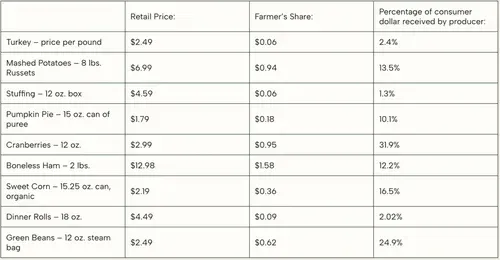
Each year, National Farmers Union releases its Thanksgiving edition of the “Farmer’s Share of the Food Dollar.” The numbers tell a clear story. For an average turkey at $2.49 a pound, the farmer receives only $0.06 a pound. A box of stuffing priced at $4.59 returns $0.06. For mashed potatoes, an eight-pound bag at $6.99 gives the grower $0.94. A can of pumpkin puree at $1.79 gives the farmer $0.18. Even dinner rolls at $4.49 a bag return only $0.09 to the wheat farmer.
Most items on the table show a farmer share below 5%. The Thanksgiving breakdown reflects a long-term trend. Farmers receive only $0.14 of every food dollar, and that share continues to shrink. Families see higher grocery bills while farmers take home less, which makes it clear that someone else in the supply chain is capturing the value.
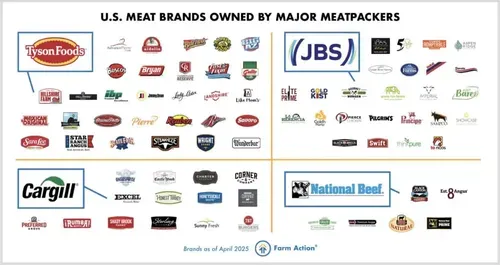
This didn’t happen by accident. For decades, a handful of corporations have gained control over nearly every link in the food chain. Today, four companies (JBS, Tyson, Cargill and National Beef) own more than 70 popular meat brands, dominating more than 80% of the beef market. A few global corporations (Bayer, Corteva, ChemChina and BASF) control seed and chemical inputs. Four mega-retailers (Walmart, Kroger, Costco and Albertsons) control more than two-thirds of the U.S. grocery market, pressuring both suppliers and consumers. When so few corporations hold so much power, they can squeeze farmers on prices while charging families more at the checkout line. This imbalance affects not only what farmers earn, but also what choices eaters have and what resources communities are able to keep in their local economies.
The consequences for our rural communities are severe. Small and mid-sized farms are disappearing as costs rise and markets become increasingly stacked against them. In Wisconsin, dairy farms continue to close at an alarming rate. Young people who want to enter farming face steep barriers, from land prices to lack of competitive markets. As farms vanish, local businesses, schools and services weaken. A rural community can’t thrive when its farmers can’t make a living.
Thanksgiving offers a moment to reflect on these realities. When you look at your holiday meal, imagine what it would mean if farmers received a better share of its value. Imagine food dollars circulating in local communities instead of being captured by distant corporations. Imagine regional processors and independent retailers building resilient supply chains that strengthen rural economies. A stronger local food system benefits everyone, not just the people who grow the ingredients.
Individual choices do have an impact; buying directly from local producers, supporting cooperatives and independent grocers, and choosing food grown and processed within the region all help keep value close to home. Reading labels, asking where food comes from, and supporting fair labor and sustainable agricultural practices also matter.
But personal choices aren’t enough. Structural change is necessary, and that means addressing industry consolidation head on. Organizations like Wisconsin Farmers Union and National Farmers Union are pushing to restore fair, open markets. In its Fairness for Farmers campaign, NFU has called for creating a 13th title in the next farm bill, one focused on competition and antitrust reform that would strengthen market oversight, improve transparency and revive tools that once protected farmers from predatory corporate behavior. This new 13th title would include:
- Robust enforcement of the Packers and Stockyards Act, a century-old law designed to protect farmers from abuse by meat companies.
- Establish an “Office of the Special Investigator for Competition Matters” at the U.S. Department of Agriculture (USDA) to aid in vigorous anti-monopoly enforcement.
- Ensure coordination between the Department of Justice (DOJ), Federal Trade Commission (FTC) and USDA to give agencies clearer authority and direction to break up unfair practices before they can damage rural economies.
- Legislation to reinstate clear country-of-origin labeling so shoppers can make informed choices.
- Enact right to repair laws so that farmers can repair their own equipment. Repair restrictions imposed by equipment manufacturers violate antitrust law, leading to increased costs, reduced choice and repair delays for farmers.
Strong and fair competition is a longstanding American value. A healthy food system depends on fair markets, transparent pricing and broad opportunity.
Antitrust enforcement isn’t about punishing success. It’s about ensuring that farmers and eaters are not trapped in markets controlled by a few dominant players. Fairness and open competition benefit everyone, especially the communities that rely heavily on agriculture for their livelihoods.
Policy change requires public pressure. When voters understand that concentration drives up grocery prices while pushing farmers out of business, they begin to see the connection between their family budget and the future of family farms. Farmers Union members have been raising these concerns at every level of government, and momentum is building because people know the current system is not working.
So yes, by all means, show gratitude for the people who grow your food. But also learn more about how the food system works. Ask your elected officials what they are doing to address corporate consolidation. Support organizations that are fighting for fair markets. Consider how your own choices can help strengthen the communities that make your holiday meal possible.
Gratitude is a great start. Action is what will keep family farms thriving for generations to come.
Memberships

Press releases and other content not written by a specific Eye On Dunn County author are listed as Eye On Dunn County Staff.


Add new comment