
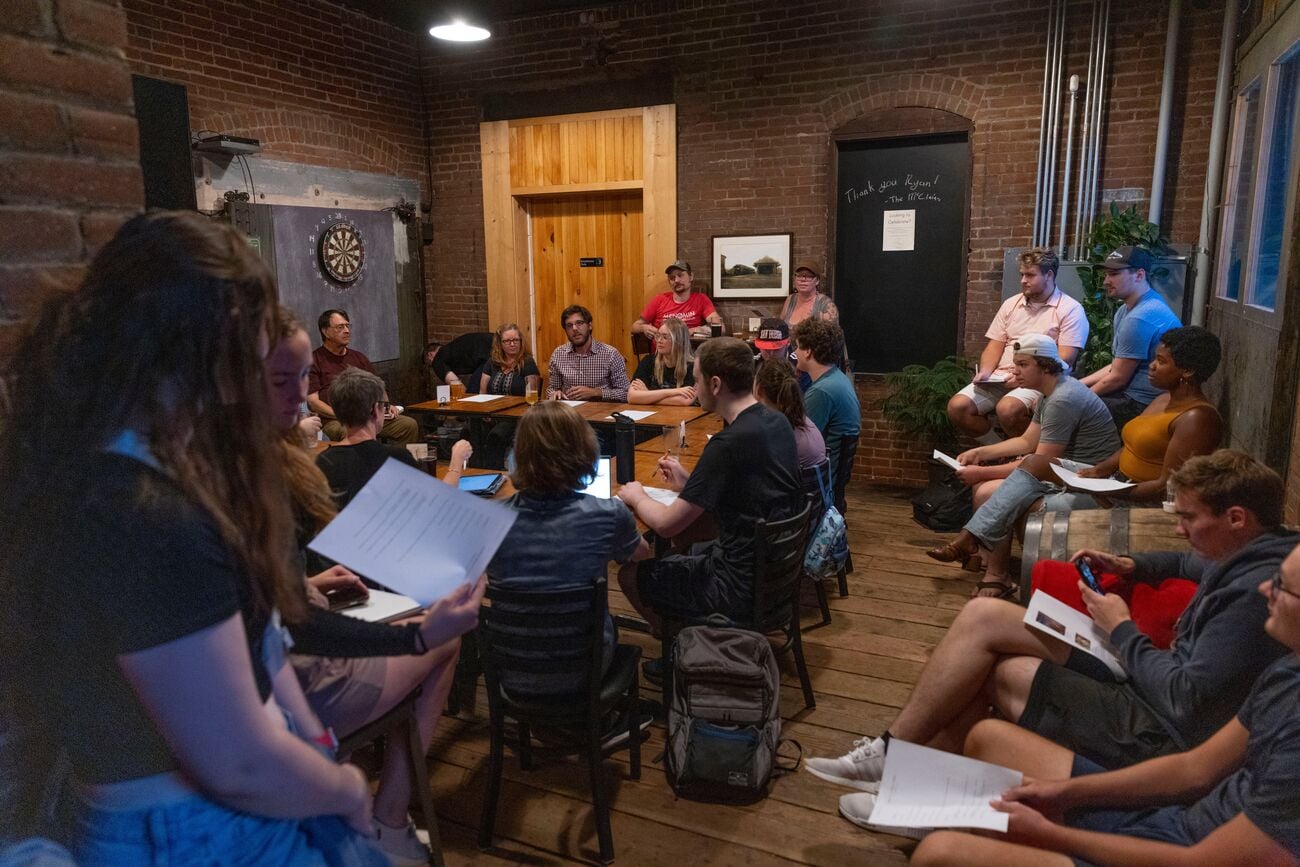
Photo courtesy UW-Stout
Living in a university town has its advantages. One of the advantages you may now know about is the Philsopher's Cafe, which is held every month at Brewery Nonic. The upcoming schedule for the Cafe is below. Give it a try!
What are Philosophers’ Cafés?
Philosophers’ Cafés are public forums held at local pubs and coffee shops in which community members engage in open, friendly, and respectful dialogue in a relaxed and informal setting. Meetings are led by faculty from UW-Stout and UW-Eau Claire, with topics ranging from traditional philosophical problems to pressing contemporary ethical issues.
Who should attend?
Everyone is welcome to attend. A diversity of views and approaches is encouraged, and no formal training in philosophy (or anything else) is required – just an interest in good questions and good conversation.
The Wisconsin Idea: What Does It Mean to You?
Date: Wednesday, November 12, 2025 | 7:00 p.m.
Location: Brewery Nønic
Moderator: Dr. Joan Navarre (English, UW-Stout)The Wisconsin Idea emerged in the early 1900s and helped put the University of Wisconsin system on the map. What is the Wisconsin Idea? What does it mean to you?
Are Gender Disparities in the Workplace a Problem?
Date: Wednesday, December 10, 2025 | 7:00 p.m.
Location: Brewery Nønic
Moderator: Dr. April Bleske-Rechek (Psychology, UW-Eau Claire)Beginning with some data on persistent gender disparities in the workplace and data from my lab on people’s reactions to various gender disparities, we can discuss a variety of questions: which gender disparities do we as a society tend to worry about, and which disparities tend to go unnoticed? What are the possible causes of gender disparities in job representation, and which of those are presumed to be the primary causes of different types of disparities (e.g., male-dominated vs female-dominated jobs)? Should our final goal be gender parity in representation for all jobs? If only some jobs, which ones? When in tension, how do we reconcile societal concern for group parity with concern for individual choice?
What Responsibility Does Society Have Toward Children?
Date: Wednesday, February 11, 2026 | 7:00 p.m.
Location: Brewery Nønic
Moderator: Dr. Tina Lee (Anthropology, UW-Stout)Since the 1960’s, all U.S. states have passed laws that require a large range of professionals to report abuse and neglect of children and created bureaucracies to field reports and investigate them. These child protective services (CPS) systems have the power to remove children from their parents and place them in foster care, with the stated aim of ensuring that vulnerable children are safe. We know, however, that Black and Indigenous children are disproportionately represented in CPS caseloads and that most reports are of neglect, which is closely tied to poverty. We also know that the United States has abysmal rates of childhood poverty and does little to support families as compared to many other high-income countries. There is also evidence that children involved with CPS face many negative outcomes. Some scholars have thus begun to refer to CPS as “family policing” and call for its abolition. What responsibility does a society have to children? What is the best way to keep children safe in the context of rising inequality? What is the balance between safety and support for parents?
Perceptions of Law and Its Discontents
Date: Wednesday, March 11, 2026 | 7:00 p.m.
Location: Brewery Nønic
Moderator: Dr. Richard Gee (Sociology, UW-Stout)Law is an arena of debate and tension. That being said, there are several different ways in which law can be viewed. Is the law an arena for conflict? Is it an arena for consensus? Is it rhetorical? Is its function to protect? We will discuss law as viewed through different avenues to illuminate the conversation around societal responses to legal decisions.
Can Wartime Dehumanization Be Avoided?
Date: Wednesday, April 8, 2026 | 7:00 p.m.
Location: Brewery Nønic
Moderator: Dr. David Seim (History, UW-Stout)Beginning with brief consideration of one case of wartime dehumanization (namely, candid admissions by Vietnam War veterans), our conversation might consider a few questions: How does a military organization mentally prepare life-valuing human beings to kill other human beings because they are the enemy? How do wartime events unfold such that combatants cease to perceive enemy combatants as fully human? Are there potential factors prior to military events that can worsen the extent of dehumanization?
Memberships

Steve is a member of LION Publishers , the Wisconsin Newspaper Association, the Menomonie Area Chamber of Commerce, the Online News Association, and the Local Media Consortium, and is active in Health Dunn Right.
He has been a computer guy most of his life but has published a political blog, a discussion website, and now Eye On Dunn County.


Add new comment