
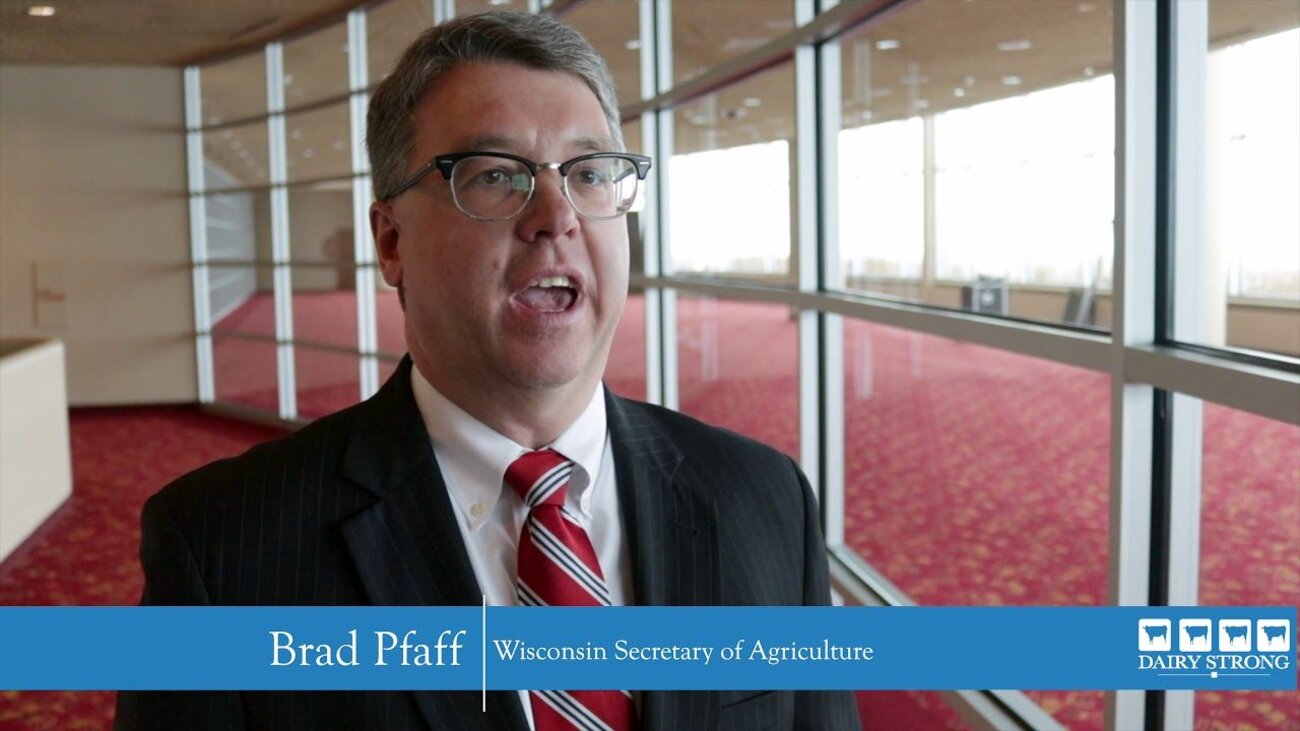
Photo Courtesy YouTube
There was some hope that when Governor Evers took office there would be progress on some of the state-wide issues that have been sitting moribund in the legislature. At least on the agricultural front, it appears that the GOP is ensuring little progress.
State-wide hearings were held on the new livestock siting rules, which are intended primarily to reign in the growing CAFO facilities around the state. Feedback from most of those present was in favor of passing the new rules, while some of the larger, more traditional farm groups were not in favor, saying that the current rules are already an intolerable burden on farmers and that tightening that control would only make matters worse.
Wisconsin Farmers Union President Darin Von Ruden reacted by saying
Wisconsin Farmers Union urges DATCP and Secretary-Designee Pfaff to reverse course immediately and bring the ATCP 51 rule revisions to a vote before the DATCP board next Thursday. To scrap the rules now is to ignore the input of hundreds of citizens who participated in the public comment process, not to mention the hundreds of hours invested by technical review committee members in 2010, 2014, and again in 2018 to make science-based recommendations for improving the rules. To abandon the revisions now at the 11th hour is a colossal waste of government resources. It's time for these rules to go forward..
Yesterday DATCP-secretary-designee Brad Pfaff announced that the new rules would not be brought forward to the DATCP board for a final vote. This is yet another example of the disappearing rule - rules and laws that disappear before anyone has a chance to vote on them. This has become the normal mode of operation in the state.
Also yesterday Senate Majority Leader Scott Fitzgerald announced that there will not be enough votes in the Senate to confirm Brad Pfaff as head of DATCP. This is apparently over a squabble over Pfaff demanding the release of funds for mental health and suicide prevention programs for farmers. Fitzgerald and spokesperson Alec Zimmerman sent an email to the Milwaukee Journal-Sentinel four days before the scheduled vote on Pfaff's nomination, stating that there were not sufficient votes and that Fitzgerald had asked Evers to remove Pfaff's name from consideration.
Evers responded by stating
It is astonishing that, in the middle of a dairy crisis and trade war, Republicans want to create even more uncertainty and instability by firing the leader of the agency charged with fighting for Wisconsin's farmers and rural communities,It is astonishing that, in the middle of a dairy crisis and trade war, Republicans want to create even more uncertainty and instability by firing the leader of the agency charged with fighting for Wisconsin's farmers and rural communities,
In the end the state seems to be ending up with no new livestock siting rules, and no DATCP secretary., all at a time when the farming industry in the state is in crisis. This is good for nobody.
Links
Memberships
Livestock Siting Law Getting a Push Back
In September of 2007 KickTime covered a Livestock Siting case in Magnolia Township that was unique because the town had zoning and wanted to put some conditional use requirements on an operation that had a history of polluting a local stream. In a "first of its kind" case brought before the Rock County Circuit Court, the judge vacated the decision of the State Livestock Facilities Siting Review Board to strip the Town-issued permit of conditions.
All the details are in the press release in the full story, but this is a huge decision that may change the uneven power relations between local units and the Wisconsin Department of Agriculture (DATCP) and their review board. The case will probably be appealed, but for the moment the circuit court seems to have applied common sense that the review board somehow could not muster.
Judge Upholds Water Quality Restrictions on Rock County Factory Farm
Contact: Peter McKeever and Christa Westerberg
Garvey McNeil & McGillivray, S.C., (608) 256-1003
[email protected]
Tony Ends, (608) 897-4288 / 354-3243
In the first case of its kind, Rock County Circuit Court Judge James E. Welker upheld the decision of the Town of Magnolia to impose conditions on a permit requested by Larson Acres, Inc., for a 1,500 animal unit dairy. The Town's conditions were intended to protect water quality by restricting landspreading of manure, requiring specified crop planting and rotation, and other measures.
The Judge's decision vacated a lower decision by the State Livestock Facilities Siting Review Board to strip the Town-issued permit of the conditions. The Judge found that the Siting Review Board had acted "beyond its powers," and that the conditions imposed by the Town were consistent with state statutes.
"[I]t would be absurd," states the opinion, "to require [local governments] to provide a scientific basis for adopting water quality standards that are already a matter of state law."
The Judge's opinion also noted that manure management standards the Department of Agriculture Trade & Consumer Protection relied on were insufficient to protect water quality: "DATCP did not exceed its authority in requiring farms to utilize this set of best management practices, but the rule should not be read as setting a new floor for environmental compliance."
"We are for farming that does not pollute water, and this landmark decision affirms our position," said Tony Ends, member of Green Rock Citizens for Clean Water. Members of the group appealed the Siting Review Board's decision to circuit court, as did the Town.
The Town originally issued the conditional use permit to Larson Acres in March 2007. Its permit imposed the conditions because the Town found that levels of nitrogen in Norwegian Creek were significantly elevated downstream of Larson's existing dairy operations, and because some residential wells were also contaminated with nitrogen.
Larson appealed that decision to the newly-formed State Livestock Facilities Siting Review Board, which in August 2008 agreed to strip the permit of the conditions the Town imposed. It was that decision that Judge Welker vacated on an appeal filed by the Town of Magnolia and members of Green-Rock Citizens for Clean Water.
The decision is the first court interpretation of the State Livestock Facilities Siting Law, enacted in April 2004. "The Court's decision is significant because it recognizes that the Livestock Facility Siting Law does not eviscerate the ability and responsibility of towns to protect water quality and safety," said Christa Westerberg, attorney for members of Green-Rock Citizens for Clean Water.
Because of the precedent-setting nature of the case, Judge Welker's decision anticipated an appeal. Accordingly, he allowed Larson to continue its operations if an appeal is filed within 30 days of his final order. The Court's decision is available at http://www.gmmattorneys.com/MemorandumDecision.12.15.08.pdf
Good News on the Wisconsin CAFO Front
There has been good news for those organizing for responsibility on the part of large animal feeding operations (CAFOs.) The conference in early April was a terrific success with good attendance from the concerned as well as ag industry. From this lift there is a new blog on the block Wisconsin_CAFO_Watch that will help organizers network and get news out to state and national environmentalists. Watch some video there from the April Conference.
And perhaps most importantly the DATCP Siting Review Board last Friday reversed the decision of the Crawford County Land and Water Board to give a siting permit to a hog confinement facility expansion planned near the Wisconsin River. The issue was decided because the plan for where the manure would go was not adequate to protect water resources. A press release that was prepared by Midwest Environmental Advocates is below the fold.
While all those pressing for responsible agriculture need to take a moment for a pat on the back, this is just one step on a very long campaign. Keep your eye on that new blog for future developments.
[Press Release from Jamie Saul, Midwest Environmental Advocates]
Madison, WI -- In a decision that bodes well for clean water, the Wisconsin Livestock Facility Siting Review Board voted on Friday to reverse Crawford County’s decision to allow the expansion of a hog confinement facility near the Kickapoo River in Wauzeka, WI. The Board reviewed the application for facility expansion prepared by Roth Feeder Pigs, Inc., found portions of it to be internally inconsistent, and expressed concerns with regard to the nutrient management data submitted by Roth. Local approval is required for such expansions in Crawford County under Wisconsin’s Livestock Facilities Siting Law and county ordinance.
A challenge to the County’s decision to issue a license to the Roth facility had been brought by Midwest Environmental Advocates on behalf of twenty-eight affected neighbors who live or own land within two miles of the facility. The challenge asserted that portions of the application submitted by Roth did not meet the state standards for nutrient management, which put local drinking water and the Kickapoo watershed at risk for nitrate, phosphorous, and bacteria contamination. Mr. Ron Stadler, a landowner near the Roth facility, brought a separate challenge on similar grounds.
“The Board rightly found this facility’s plan to pollute unacceptable,” said Jamie Saul, Staff Attorney with Midwest Environmental Advocates. “It was clear from the start that this facility’s application did not meet the standards for nutrient management required by state law.” Proper nutrient management planning is essential to protect land and water from over-application of livestock manure.
“We are pleased that the Board took an in-depth look at the application and made the right decision,” said Bob Lenz, one of the twenty-eight neighbors who were named in the challenge. Concerned neighbors and members of the Crawford Stewardship Project (CSP) worked hard gathering information and presenting compelling testimony on the environmental and public health risks associated with this hog facility to the Crawford County Land Conservation Committee, who nonetheless voted to approve the expansion in January.
“The Crawford Stewardship Project is very pleased that the Board took its role seriously, looked at the record objectively, and by reversing the County’s decision took a stance to protect our air and water as required by law,” stated Jennifer Nelson of the CSP.
While the decision of the Board is binding on Crawford County, nothing prevents Roth from re-applying for local approval under the Livestock Siting Law. The County itself has the option of appealing the Board’s decision to circuit court. In addition, Roth must acquire a wastewater discharge permit from the Department of Natural Resources, which is mandatory for all livestock operations that house 1,000 animal units or more on site.

Steve is a member of LION Publishers , the Wisconsin Newspaper Association, the Menomonie Area Chamber of Commerce, the Online News Association, and the Local Media Consortium, and is active in Health Dunn Right.
He has been a computer guy most of his life but has published a political blog, a discussion website, and now Eye On Dunn County.


Add new comment